Native Plants

Plant Database
Search for native plants by scientific name, common name or family. If you are not sure what you are looking for, try the Combination Search or our Recommended Species lists.
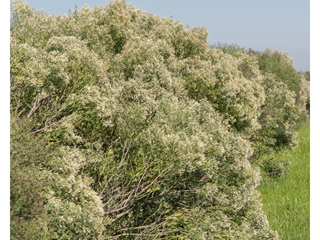
Romfh, Peggy
Baccharis halimifolia
Baccharis halimifolia L.
Groundseltree, Sea-myrtle, Consumptionweed, Eastern Baccharis, Groundsel, Groundsel Bush, Salt Marsh-elder, Salt Bush, Florida Groundsel Bush
Asteraceae (Aster Family)
Synonym(s): Baccharis halimifolia var. angustior
USDA Symbol: baha
USDA Native Status: L48 (N)
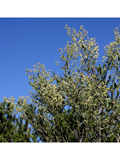
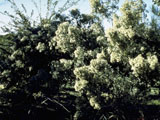
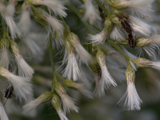
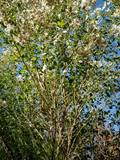
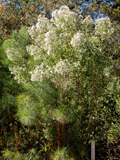
Groundseltree or sea myrtle’s numerous branches from short trunks are covered densely with branchlets. The 6-12 ft. , deciduous shrub bears gray-green, somewhat lobed, oval leaves which are semi-persistent in the North. White to green flowers occur in small, dense, terminal clusters. Probably the most significant landscape feature is the silvery, plume-like achenes which appear in the fall on female plants resembling silvery paintbrushes.
Apparently extending its natural range inland from the coastal plain, Florida Groundsel Bush is the only native eastern species of the aster family reaching tree size. Baccharis is the ancient Greek name (derived from the god Bacchus) of a plant with fragrant roots. The Latin species name means "with the leaves of Halimus," an old name for Saltbush, an unrelated shrub. Tolerant of saltwater spray, this handsome ornamental is one of the few eastern shrubs suitable for planting near the ocean.
Plant Characteristics
Duration: PerennialHabit: Shrub
Leaf Retention: Semi-evergreen
Leaf Arrangement: Alternate
Breeding System: Flowers Unisexual , Dioecious
Size Notes: Height to 15 feet.
Leaf: Of two kinds: those subtending the flowering heads elliptic, rounded or slightly pointed at the tip, toothless, smooth; those lower on the stern elliptic-ovate to ovate, pointed at the tip, coarsely toothed, smooth, up to 3 inches long.
Autumn Foliage: yes
Flower: Many crowded together into heads, all very narrowly tubular, whitish, with several flowers per head; each head up to 1/8 inch long, subtended by narrow, green-tipped bracts.
Fruit: Fruit is a cypsela (pl. cypselae). Though technically incorrect, the fruit is often referred to as an achene. Fruit flattened, ribbed, very small, subtended by white hairs called the pappus.
Bloom Information
Bloom Color: WhiteBloom Time: Aug , Sep , Oct
Distribution
USA: AL , AR , CT , DC , DE , FL , GA , LA , MA , MD , MS , NC , NJ , NY , OK , PA , RI , SC , TX , VANative Distribution: Mex. & e. TX to FL, n. to coast of MA; believed to have once been restricted to the outer Coastal Plain, but now widely spread inland
Native Habitat: Salt marshes; shores; wet, disturbed places
Growing Conditions
Water Use: HighLight Requirement: Part Shade
Soil Moisture: Wet
Soil pH: Circumneutral (pH 6.8-7.2)
CaCO3 Tolerance: Low
Soil Description: Wet to droughty, gravel to fine sands. Sandy Loam, Sandy, Acid-based.
Conditions Comments: No disease or insect problems, but the weak wood is easily broken. Fast-growing. Salt tolerant.
Benefit
Use Ornamental: Showy, Erosion controlUse Wildlife: Cover, Nectar-bees, Nectar-butterflies, Nectar-moths, Nectar-insects, Seeds-granivorous birds
Conspicuous Flowers: yes
Attracts: Birds
Propagation
Description: Increase by sowing seed or taking cuttings in summer. Germinating seeds under mist or a plastic tent is recommended in some sources. Others suggest sowing seeds in sandy seed beds in fall or early spring.Seed Treatment: No pretreatment is necessary.
Commercially Avail: yes
National Wetland Indicator Status
| Region: | AGCP | AK | AW | CB | EMP | GP | HI | MW | NCNE | WMVE |
| Status: | FAC | FACW | FAC | FACW |
From the National Organizations Directory
According to the species list provided by Affiliate Organizations, this plant is on display at the following locations:Crosby Arboretum - Picayune, MS
Natural Biodiversity - Johnstown, PA
Wellspring Organic Farm and Education Center - West Bend, WI
Bibliography
Bibref 841 - Native Alternatives to Invasive Plants (2006) Burrell, C. C.Bibref 318 - Native Texas Plants: Landscaping Region by Region (2002) Wasowski, S. & A. Wasowski
Bibref 291 - Texas Wildscapes: Gardening for Wildlife (1999) Damude, N. & K.C. Bender
Search More Titles in Bibliography
Additional resources
USDA: Find Baccharis halimifolia in USDA PlantsFNA: Find Baccharis halimifolia in the Flora of North America (if available)
Google: Search Google for Baccharis halimifolia
Metadata
Record Modified: 2016-01-13Research By: TWC Staff