Native Plants

Plant Database
Search for native plants by scientific name, common name or family. If you are not sure what you are looking for, try the Combination Search or our Recommended Species lists.
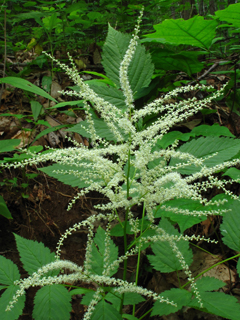
Cressler, Alan
Aruncus dioicus
Aruncus dioicus (Walter) Fernald
Bride's Feathers, Goat's Beard
Rosaceae (Rose Family)
Synonym(s):
USDA Symbol: ardi8
USDA Native Status: L48 (NI), AK (N), CAN (N)
This species includes botanical varieties that are North American natives. However, it also includes botanical varieties that are not native to North America, e.g. Aruncus dioicus var. vulgaris, Bride's Feathers. Non-native taxa are not treated in this database.
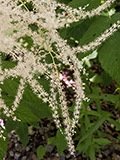
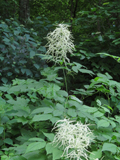
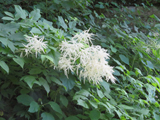
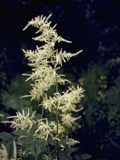
Bride’s-feathers or Goat’s Beard is an imposing perennial, 3-6 ft tall. The stems bear several twice- or thrice-pinnately compound leaves, the segments prominently toothed. The large, feathery clusters of small, white flowers are reminiscent of astilbes. Male and female flowers are borne on separate plants, the staminate being more attractive.
Aruncus, from the Greek aryngos ("goat’s beard"), refers to the showy, finger-like flower clusters, which form feathery masses of all male or all female flowers. The species occurs around the Northern Hemisphere. The western plants once comprised a separate species, known as A. sylvester, among other names. Classification is still unsettled; some botanists consider western plants to be the variety pubescens, others consider them to be the variety acuminatus. The very similar False Goatsbeard (Astilbe biternata), of the saxifrage family (Saxifragaceae), has a lobed terminal leaflet on each leaf and two pistils.

Plant Characteristics
Duration: PerennialHabit: Herb
Root Type: Tap
Leaf Margin: Dentate
Breeding System: Flowers Unisexual , Dioecious
Fruit Type: Follicle
Size Notes: Up to about 6 feet tall.
Flower: Flower clusters 6 to 24 inches long.
Bloom Information
Bloom Color: WhiteBloom Time: May , Jun , Jul , Aug
Bloom Notes: Male plants have showier flowers.
Distribution
USA: AK , AL , AR , CA , DC , GA , IA , IL , IN , KY , MA , MD , ME , MI , MO , MS , NC , NJ , NY , OH , OK , OR , PA , SC , TN , VA , WA , WVCanada: AB , BC
Native Distribution: PA and IA, south to NC, AL, & AR
Native Habitat: Damp, fertile woods, mountainous areas
Growing Conditions
Water Use: Medium , HighLight Requirement: Sun , Part Shade , Shade
Soil Moisture: Moist , Wet
Soil pH: Acidic (pH<6.8)
Soil Description: Average to acid, mesic to moist soil.
Conditions Comments: Tolerates seasonal flooding. Needs a lot of space.
Benefit
Use Ornamental: Good for large-scale displays of white blooms in spring and summer, such as massed in a drift down a slope.Conspicuous Flowers: yes
Attracts: Butterflies
Larval Host: Dusky Azure
Butterflies and Moths of North America (BAMONA)
|
Dusky Azure (Celastrina nigra) 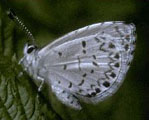 Larval Host |
Propagation
Propagation Material: Root Division , SeedsDescription: Propagate by division or seed.
Seed Collection: Ripens one month after blooming, female plants only.
Commercially Avail: yes
Mr. Smarty Plants says
Native shade plants around fountain in California
March 18, 2009
Hi, we just put a fountain in our front yard. It is in a mostly shady area. I need to know what plants would go best around the fountain and survive in the shade.
view the full question and answer
National Wetland Indicator Status
| Region: | AGCP | AK | AW | CB | EMP | GP | HI | MW | NCNE | WMVE |
| Status: | FACU | UPL | FACU | FACU | FACU | FACU | FACU |
From the National Organizations Directory
According to the species list provided by Affiliate Organizations, this plant is on display at the following locations:Delaware Nature Society - Hockessin, DE
Natural Biodiversity - Johnstown, PA
Mt. Cuba Center - Hockessin, DE
Bibliography
Bibref 1186 - Field Guide to Moths of Eastern North America (2005) Covell, C.V., Jr.Bibref 1185 - Field Guide to Western Butterflies (Peterson Field Guides) (1999) Opler, P.A. and A.B. Wright
Bibref 1620 - Gardening with Native Plants of the South (Reprint Edition) (2009) Wasowski, S. with A. Wasowski
Bibref 841 - Native Alternatives to Invasive Plants (2006) Burrell, C. C.
Bibref 1294 - The Midwestern Native Garden: Native Alternatives to Nonnative Flowers and Plants An Illustrated Guide (2011) Adelman, Charlotte and Schwartz, Bernard L.
Search More Titles in Bibliography
Web Reference
Webref 30 - Calflora (2018) CalfloraWebref 38 - Flora of North America (2019) Missouri Botanical Garden, St. Louis, MO & Harvard University Herbaria, Cambridge, MA.
Webref 23 - Southwest Environmental Information Network (2009) SEINet - Arizona Chapter
Additional resources
USDA: Find Aruncus dioicus in USDA PlantsFNA: Find Aruncus dioicus in the Flora of North America (if available)
Google: Search Google for Aruncus dioicus
Metadata
Record Modified: 2023-05-09Research By: TWC Staff