Native Plants

Plant Database
Search for native plants by scientific name, common name or family. If you are not sure what you are looking for, try the Combination Search or our Recommended Species lists.
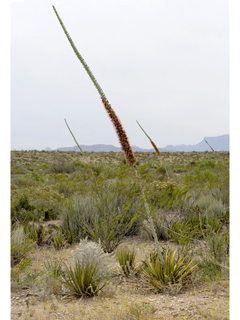
Braden, Al
Agave lechuguilla
Agave lechuguilla Torr.
Lechuguilla, Tula Ixtle, Maguey Lechuguilla, Shindagger
Agavaceae (Century-Plant Family)
Synonym(s): Agave lophantha var. poselgeri
USDA Symbol: agle
USDA Native Status: L48 (N)
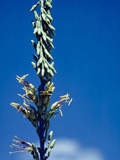
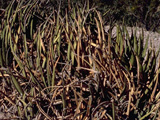
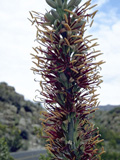
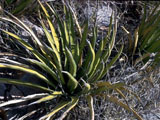
The succulent, yellow-green rosettes of lechuguilla are 1-2 ft. tall and widely suckering. Thick, leathery leaves are tipped with a strong spine. The lechuguilla, like its relative, the maguey or century plant, requires 12-15 years to store up enough food for the production of the large flower stalk, which then grows amazingly fast up to 15 feet tall. The stalk is unbranched and flexible, so that it often bends when it is heavy with buds or flowers, retaining a permanent, graceful arc. The upper part of the stalk is covered with a solid mass of purplish or yellowish flowers. After producing flowers and seeds, the stalk dies.
This formidable plant was a dangerous obstacle in the early exploration of the Southwest. The sharp leaves pierced horses' legs, and a rider who fell could be impaled. Horses familiar with the country can usually avoid it.

Plant Characteristics
Duration: PerennialHabit: Cactus/Succulent
Leaf Complexity: Simple
Fruit Type: Capsule
Size Notes: Up to about 2 feet tall when not flowering. Flower stalk up to about 15 feet tall.
Bloom Information
Bloom Color: White , Pink , YellowBloom Time: May , Jun , Jul
Distribution
USA: NM , TXNative Distribution: W. TX, s. NM & Mex.
Native Habitat: Desert plains; mountains
Growing Conditions
Water Use: LowLight Requirement: Sun
Soil Moisture: Dry
Cold Tolerant: yes
Heat Tolerant: yes
Soil Description: Dry, rocky, limestone soils.
Conditions Comments: The succulent, yellow-green rosettes of lechuguilla are widely suckering. Thick, leathery leaves are tipped with a strong spine. A cluster of yellow to pinkish-white flowers occurs on a 6-9 ft. stalk which rises from center of rosette after 8-20 years. After setting fruit, the entire plant dies. This agave is often cultivated in rock gardens. It is tolerant of poor, acid soil.
Benefit
Use Wildlife: The plant reproduces by putting out offshoots, which are often eaten by deer and javelinas.Use Food: The hearts not safe to eat. Dangerously high concentrations of saponins and other toxic compounds.(Tull) Pulque, mescal, and tequila are made from the fermented sap of the flower stalk.
Use Medicinal: Toxic juice from leaves used as arrow poison, a fish stupefier, a medicine and a soap. (Tull) Tarahumara people of Mexico once used the plant's poisonous compounds on their arrows and in water to poison fish.
Use Other: Leaf fibers for cordage for bow strings, nets, baskets, mats, sandals, blankets, and cloth. Roots pounded and soaked in water used for soap and shampoo. (Tull) Native Americans obtained fiber from the leaves to make rope, mats, and baskets.
Warning: Certain compounds in Lechuguilla are poisonous, and livestock can die from eating this plant during a drought, when the succulent leaves become the forage of last resort. Humans should generally avoid consuming any plants that are toxic to animals. The leaves of Lechuguilla are so sharp they can cause injury to animals and humans and can even puncture the tires of off-road vehicles.
Interesting Foliage: yes
Butterflies and Moths of North America (BAMONA)
|
Coahuila Giant-Skipper (Agathymus remingtoni) 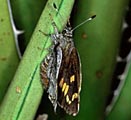 Larval Host |
Propagation
Propagation Material: SeedsDescription: Fresh, untreated seed. Young plants, which grow around the base of the rosette, may be separated and transplanted in late winter and early spring.
Seed Collection: As soon as capsules begin to dry out and turn brown but before they split and disperse the seeds (late summer through fall). Seeds can be stored for one year in refrigerated, ventilated containers.
Commercially Avail: yes
From the National Organizations Directory
According to the species list provided by Affiliate Organizations, this plant is on display at the following locations:NPSOT - Austin Chapter - Austin, TX
Bibliography
Bibref 1186 - Field Guide to Moths of Eastern North America (2005) Covell, C.V., Jr.Bibref 1185 - Field Guide to Western Butterflies (Peterson Field Guides) (1999) Opler, P.A. and A.B. Wright
Bibref 355 - Landscaping with Native Plants of Texas and the Southwest (1991) Miller, G. O.
Bibref 308 - Lone Star Field Guide to Wildflowers, Trees, and Shrubs of Texas, Revised Edition (2003) Tull, D. & G.O. Miller
Bibref 995 - Native Landscaping from El Paso to L.A. (2000) Wasowski, S. and A. Wasowski
Bibref 248 - Texas Wildflowers: A Field Guide (1984) Loughmiller, C. & L. Loughmiller
Search More Titles in Bibliography
From the Archive
Wildflower Newsletter 1988 VOL. 5, NO.5 - Penny Campaign Grows Oklahoma Wildflowers, Wildflower Center Collects Honors, Di...Wildflower Newsletter 1990 VOL. 7, NO.2 - Preservation Blooms in Recreated Prairies, New Wildflower Center Prairie Welcome...
Wildflower Newsletter 1996 VOL. 13, NO.5 - Bats as Cacti Pollinators, Fall Foliage Hotlines, Creating Fall Foliage Leafprin...
Additional resources
USDA: Find Agave lechuguilla in USDA PlantsFNA: Find Agave lechuguilla in the Flora of North America (if available)
Google: Search Google for Agave lechuguilla
Metadata
Record Modified: 2021-07-21Research By: TWC Staff