Native Plants

Plant Database
Search for native plants by scientific name, common name or family. If you are not sure what you are looking for, try the Combination Search or our Recommended Species lists.
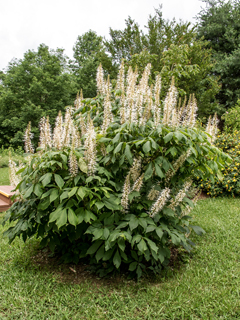
Brundage, Stephanie
Aesculus parviflora
Aesculus parviflora Walter
Bottlebrush Buckeye
Hippocastanaceae (Horse-Chestnut Family)
Synonym(s):
USDA Symbol: aepa2
USDA Native Status: L48 (N)
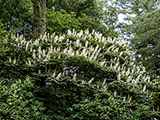
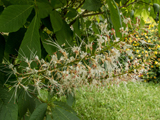
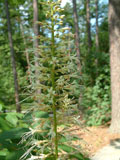
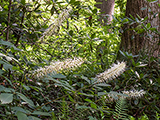
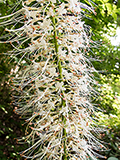
A distinctive small buckeye, Bottlebrush is a mound-shaped, thicket-forming, deciduous shrub, 6-12 ft. tall, with picturesque, ascending, candelabra-like branching. Lowest branches are horizontal and often rest on the ground. Palmately-compound leaves turn from dark-green to yellow-green in fall. Tall, cylindric spikes of feathery white flowers with pink stamens and red anthers bloom in the heat of early summer after other eastern buckeyes have finished. The smooth seed is enclosed by a bright yellow husk.
Though susceptible to leaf scorch, bottlebrush is unique among the buckeyes for retaining its foliage, in good condition, well into fall. It is more tolerant of disease and insects than most buckeyes. Leaves may become quite colorful in fall; seemingly dependent on environmental conditions. Excellent for borders, as a specimen, or under shade trees.
Plant Characteristics
Duration: PerennialHabit: Shrub
Leaf Retention: Deciduous
Leaf Arrangement: Opposite
Leaf Complexity: Palmate
Leaf Margin: Serrate
Fruit Type: Capsule
Size Notes: Shrub up to 15 feet tall.
Bloom Information
Bloom Color: WhiteBloom Time: Jun , Jul
Distribution
USA: AL , DC , GA , NJ , PA , SCNative Distribution: C. GA to AL & SC
Native Habitat: Rich, mesic woods; moist ravines
Growing Conditions
Light Requirement: Part ShadeSoil Description: Moist, well-drained, shallow soils over limestone or loamy sands.
Conditions Comments: Though susceptible to leaf scorch, bottlebrush is unique among the buckeyes for retaining its foliage, in good condition, well into fall. It is more tolerant of disease and insects than most buckeyes. Leaves may become quite colorful in fall; seemingly dependent on environmental conditions. Excellent for borders, as a specimen, or under shade trees.
Benefit
Use Wildlife: Flowers attract hummingbirds and butterflies.Warning: Seeds and foliage of Aesculus species are poisonous to humans if eaten. Sensitivity to a toxin varies with a person’s age, weight, physical condition, and individual susceptibility. Children are most vulnerable because of their curiosity and small size. Toxicity can vary in a plant according to season, the plant’s different parts, and its stage of growth; and plants can absorb toxic substances, such as herbicides, pesticides, and pollutants from the water, air, and soil.
Interesting Foliage: yes
Propagation
Description: Seeds should be planted as soon as possible after they are collected and never allowed to dry out. Softwood cuttings under mist root in fair percentages. The commercial method of propagating bottlebrush buckeye is root cuttings.Seed Collection: Seeds dry and shrivel quickly.
Seed Treatment: Minimal cool stratification (30 days) seems beneficial.
Commercially Avail: yes
From the National Organizations Directory
According to the species list provided by Affiliate Organizations, this plant is on display at the following locations:Delaware Nature Society - Hockessin, DE
Georgia Native Plant Society - Atlanta, GA
Natural Biodiversity - Johnstown, PA
Mt. Cuba Center - Hockessin, DE
Bibliography
Bibref 1620 - Gardening with Native Plants of the South (Reprint Edition) (2009) Wasowski, S. with A. WasowskiBibref 841 - Native Alternatives to Invasive Plants (2006) Burrell, C. C.
Search More Titles in Bibliography
Web Reference
Webref 23 - Southwest Environmental Information Network (2009) SEINet - Arizona ChapterAdditional resources
USDA: Find Aesculus parviflora in USDA PlantsFNA: Find Aesculus parviflora in the Flora of North America (if available)
Google: Search Google for Aesculus parviflora
Metadata
Record Modified: 2023-04-05Research By: TWC Staff