Native Plants

Plant Database
Search for native plants by scientific name, common name or family. If you are not sure what you are looking for, try the Combination Search or our Recommended Species lists.
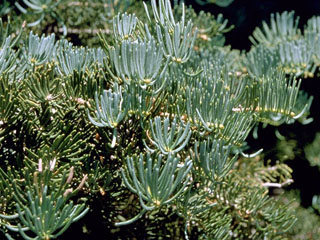
Flaigg, Norman G.
Abies concolor
Abies concolor (Gord. & Glend.) Lindl. ex Hildebr.
White Fir, Balsam Fir, Colorado Fir, Concolor Fir, Silver Fir, White Balsam, Oyamel De California
Pinaceae (Pine Family)
Synonym(s): Abies concolor var. concolor
USDA Symbol: abco
USDA Native Status: L48 (N)
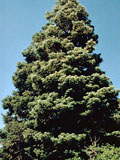
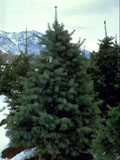
Symetrically conical in youth, this evergreen becomes more irregular and rounded with age. It grows to a height of 50-130 ft. Lower branches extend to ground when open-grown but when crowded, half or more of the trunk is bare. Needles are silvery blue-green and 2-3 in. long - the longest of any fir. White fir derives its name from its silvery-white bark. Very large fir, widespread in western mountains, with narrow, pointed crown of short, symmetrical, horizontal branches; 2 geographic varieties.
Rocky Mountain White Fir (var. concolor), of the Rocky Mountain region, grows in the warmest and driest climate of all native firs. California White Fir (var. lowiana (Gord.) Lemm.), the Pacific Coast variety, is grown for ornament, shade, and Christmas trees. The scientific name, meaning "of uniform color," refers to both needle surfaces.
Plant Characteristics
Duration: PerennialHabit: Tree
Root Type: Tap
Leaf Retention: Evergreen
Leaf Complexity: Simple
Leaf Shape: Linear
Leaf Margin: Entire
Breeding System: Flowers Unisexual , Monoecious
Fruit Type: Cone
Size Notes: Up to about 130 feet tall, spread up to about 60 feet.
Leaf: Yellowish-green to bluish-green in young trees turning whitish with age.
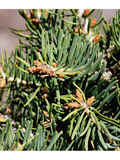
Fruit: Cones purplish, olive-green or dark yellowish-green. Cylindrical, 2 to 5 1/2 inches long.
Bloom Information
Bloom Color: RedBloom Time: Apr , May , Jun
Distribution
USA: AZ , CA , CO , ID , MA , ME , NM , NV , OR , UT , WYNative Distribution: S.w. ID & s.e. OR, w. to mts. of c. CO, & s. to s. CA, AZ & NM
Native Habitat: Arid mt. areas; dry slopes; rocky places
Growing Conditions
Water Use: MediumLight Requirement: Sun , Part Shade
CaCO3 Tolerance: Low
Drought Tolerance: High
Cold Tolerant: yes
Soil Description: Well-drained, gravelly or sandy-loam soils.
Conditions Comments: Western white fir transplants readily and is drought- & cold- tolerant. It will adapt to most soils, except heavy clay. Under good conditions, 1 to 1 1/2 ft. of growth can be expected per season, but this is generally a very slow-growing tree. It tolerates light shade and has no serious disease and insect problems. This species benefits from the protection of a "mother" plant the first 10 years.
Benefit
Use Wildlife: The winged seeds of this and other firs are eaten by songbirds and various mammals, especially squirrels and chipmunks. Deer and grouse feed on the foliage; porcupines gnaw the bark.Use Other: Wood used for paper pulp and general lumber for building construction.
Interesting Foliage: yes
Attracts: Birds
Propagation
Propagation Material: Seeds , Softwood CuttingsDescription: Seed is the easiest method of propagation. In nature, Abies seeds often germinate on melting snow fields. Cuttings should be taken from December through March and seem to root best if treated with hormone.
Seed Collection: Cone scales bear two seeds at the base. Mature seed has a large wing and is ovoid to oblong. Seeds can be damaged easily. Seeds store best in a dry, cool environment.
Seed Treatment: Stratify seeds 1 1/2 months.
Commercially Avail: yes
Maintenance: Pruning is not necessary.
Find Seed or Plants
View propagation protocol from Native Plants Network.
Mr. Smarty Plants says
Columnar evergreen for Colorado
July 04, 2008
I am looking for an evergreen 6-8 (or more) feet tall, very columnar; 3 feet spread in diameter, zone 5, full sun, dark green, clayish-OK soil.
Thank you so much!
view the full question and answer
From the National Organizations Directory
According to the species list provided by Affiliate Organizations, this plant is on display at the following locations:Santa Barbara Botanic Garden - Santa Barbara, CA
Bibliography
Bibref 698 - Native Plants for Use in the California Landscape (1978) Labadie, E. L.Search More Titles in Bibliography
Additional resources
USDA: Find Abies concolor in USDA PlantsFNA: Find Abies concolor in the Flora of North America (if available)
Google: Search Google for Abies concolor
Metadata
Record Modified: 2021-02-05Research By: TWC Staff