Native Plants

Plant Database
Search for native plants by scientific name, common name or family. If you are not sure what you are looking for, try the Combination Search or our Recommended Species lists.
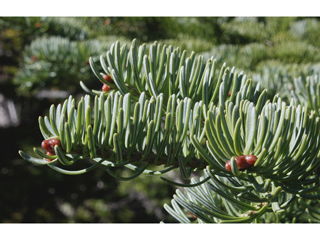
Smith, R.W.
Abies balsamea
Abies balsamea (L.) Mill.
Balsam Fir, Blister Pine, Northern Balsam
Pinaceae (Pine Family)
Synonym(s):
USDA Symbol: abba
USDA Native Status: L48 (N), CAN (N), SPM (N)
The only fir native to the Northeast, with narrow, pointed, spirelike crown of spreading branches and aromatic foliage.
A major pulpwood species. Interior knotty pine paneling is a special product; Canada balsam, an aromatic oleoresin obtained from swellings or resin blisters in the bark, is used for mounting microscopic specimens and for optical cement. Wood is used for pulp and paper.
From the Image Gallery
Plant Characteristics
Duration: PerennialHabit: Tree
Leaf Retention: Evergreen
Leaf Complexity: Simple
Leaf Shape: Linear
Breeding System: Flowers Unisexual , Monoecious
Fruit Type: Cone
Size Notes: Up to about 75 feet tall.
Leaf: Green
Fruit: Purple, Brown 2-3.5 in.
Bloom Information
Bloom Color: Yellow , Green , Purple , BrownBloom Time: Sep , Oct , Nov
Distribution
USA: CT , IA , IN , MA , MD , ME , MI , MN , NH , NY , OH , PA , RI , VA , VT , WI , WVCanada: AB , BC , MB , NB , NL , NS , ON , PE , QC , SK , YT
Native Distribution: Lab. & Nf. to MN & s. Man., s. to VA & n.e. IA; in North on low, swampy ground to well-drained uplands; in South above 3600 ft.
Native Habitat: Woodland, Riparian, Swamp, Marsh
Growing Conditions
Water Use: MediumLight Requirement: Sun , Part Shade , Shade
Soil Moisture: Moist
Soil pH: Acidic (pH<6.8)
CaCO3 Tolerance: Low
Cold Tolerant: yes
Soil Description: Well-drained, acid, moist soils.
Conditions Comments: This slow-growing tree loses its lower branches as it matures, but maintains its dense, spire-like habit throughout its life. It needs to be kept cool and moist during the growing season. It is troubled by spruce budworm, woolly aphid and several canker diseases and is heavily browsed by deer. It is very resistant to attack by gypsy moth. The soft foliage makes balsam a favorite Christmas tree.
Benefit
Use Ornamental: A common Christmas tree species. Christmas trees, wreaths, and balsam pillows utilize the aromatic foliage.Use Wildlife: Songbirds and squirrels eat seed and deer browse foliage. Deer and moose browse the foliage in winter.
Use Other: Balsam has the fortunate property of refracting light to exactly the same extent that glass does so that the balsam matrix, the cover glass, and the microscope lenses become one optical system with the same refractive index. (Peattie)
Fragrant Flowers: yes
Interesting Foliage: yes
Fragrant Foliage: yes
Attracts: Birds , Butterflies
Propagation
Description: Abies spp. are best propagated by means of seeds sown in early spring. In nature, Abies seeds often germinate on melting snow fields.Seed Collection: Cone scales bear two seeds at the base. Mature seed has a large wing and is ovoid to oblong. Seeds can be damaged easily. Seeds store best in a dry, cool environment.
Seed Treatment: A stratification period of 15-30 days in moist medium at 34-41 degrees is recommended.
Commercially Avail: yes
Find Seed or Plants
View propagation protocol from Native Plants Network.
National Wetland Indicator Status
| Region: | AGCP | AK | AW | CB | EMP | GP | HI | MW | NCNE | WMVE |
| Status: | FAC | FAC | FACW | FAC |
From the National Organizations Directory
According to the species list provided by Affiliate Organizations, this plant is on display at the following locations:Natural Biodiversity - Johnstown, PA
Mt. Cuba Center - Hockessin, DE
Additional resources
USDA: Find Abies balsamea in USDA PlantsFNA: Find Abies balsamea in the Flora of North America (if available)
Google: Search Google for Abies balsamea
Metadata
Record Modified: 2018-10-10Research By: DEW