Native Plants

Plant Database
Search for native plants by scientific name, common name or family. If you are not sure what you are looking for, try the Combination Search or our Recommended Species lists.
Cressler, Alan
Zamia pumila
Zamia pumila L.
Coontie, Florida Arrowroot
Zamiaceae (Sago-palm Family)
Synonym(s):
USDA Symbol: ZAPU
USDA Native Status: L48 (N), PR (N)
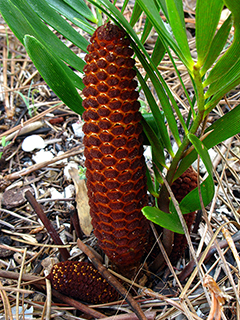
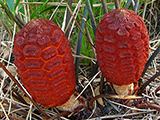
The short, woody stem and rootstock of this primitive fern-like plant is almost completely underground and produces a terminal crown of stiff, evergreen, pinnate leaves up to 3 ft. long. The brown, fleshy, erect, female or seed-bearing cones, 6-8 in. long, are pendent when mature and covered with dark-brown hairs.
Zamia is one of only a few primitive or ‘relict’ genera, commonly called cycads that are living remnants of plants that were abundant about 325 million years ago. Zamia pumila is the only species of this genus that grows in the United States.
Plant Characteristics
Duration: PerennialHabit: Shrub
Root Type: Tap
Leaf Retention: Evergreen
Leaf Complexity: Pinnate
Breeding System: Flowers Unisexual , Dioecious
Fruit Type: Cone
Size Notes: Up to about 3 feet tall.
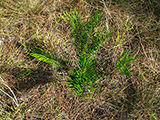
Leaf: Dark green fronds
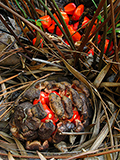
Fruit: Red to red-orange seeds 12-13 cm
Bloom Information
Bloom Color: Green , BrownBloom Time: Jul , Aug
Distribution
USA: FL , GANative Distribution: Endemic to central and southern Florida.
Native Habitat: Plants grow in dry, sandy pinelands and hammocks. Rarely occur in sandy coastal dunes.
Growing Conditions
Water Use: LowLight Requirement: Sun
Soil Moisture: Dry
Heat Tolerant: yes
Soil Description: Well-drained soil with a light, organic cover.
Conditions Comments: Drought-tolerant. Makes a good foundation planting or ground cover if not walked on.
Benefit
Use Wildlife: Coontie cones reportedly provide food in exchange for pollination services for two species of beetles in Florida, Pharaxonotha zamiae and Rhopalotria slossoni. The seeds are a source of food for mockingbirds, blue jays, and many other birds as well as insects and small mammals.Use Food: The Seminole, Alabama, and many other Native American tribes in the southeastern United States used the fruits and roots of coontie for food. Some people still prepare it today. The starchy stems and roots were the main source of flour for the Seminoles and many indigenous people of central and southern Florida. These peoples are attributed with increasing the plant’s distribution. The plant parts contain central nervous system toxins, which must be removed before consumption.
Warning: The roots of coontie are toxic when taken internally, without sufficient preparation.
Interesting Foliage: yes
Attracts: Birds , Butterflies
Butterflies and Moths of North America (BAMONA)
|
Atala (Eumaeus atala) 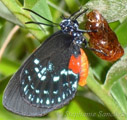 Larval Host |
Propagation
Description: Can be propagated from seed. Cleaned seeds should be spread on the ground and covered with a thin layer of leaves or soil. After sprouting in six weeks that plants can be transferred to pots.Seed Treatment: Clean seeds of their sticky covering.
Commercially Avail: yes
Find Seed or Plants
Find seed sources for this species at the Native Seed Network.
View propagation protocol from Native Plants Network.
Mr. Smarty Plants says
Native ground cover to replace grass in Florida.
February 04, 2008
Where can I find a list of ground covers to replace my grass. I live in the south of Ocala Florida.
view the full question and answer
From the National Organizations Directory
According to the species list provided by Affiliate Organizations, this plant is on display at the following locations:Native Seed Network - Corvallis, OR
Bibliography
Bibref 1186 - Field Guide to Moths of Eastern North America (2005) Covell, C.V., Jr.Bibref 1185 - Field Guide to Western Butterflies (Peterson Field Guides) (1999) Opler, P.A. and A.B. Wright
Search More Titles in Bibliography
Research Literature
Reslit 1223 - Postestablishment landscape performance of Florida native and exotic shrubs under irrigated and nonirrigated conditions (2008) S. M. Scheiber, E. F. Gilman, D. R. Sandrock, M. P...Reslit 2649 - Arbuscular mycorrhizal fungi promote growth and phosphorus uptake in Zamia, a native Florida cycad (2008) J. B. Fisher, K. Jayachandran
Reslit 2650 - Propagation protocol for the native cycad coontie (Zamia pumila L.) (2007) D. Chiappini
Reslit 2651 - Effects of varying shade and fertilizer on the growth of Zamia floridana A. DC (2004) B. Dehgan, F. C. Almira, A. E. Dudeck, B. Schutzma...
Reslit 2652 - Effects of fire season and postfire herbivory on the cycad Zamia pumila (Zamiaceae) in slash pine savanna, Everglades National Park, Florida (2000) V. Negron-Ortiz, D. L. Gorchov
Reslit 2653 - Organogenesis in female gametophyte and embryo cultures of cycads: Cycas circinalis and Zamia integrifolia (2000) M. Dhiman, S. Moitra, M. N. Singh, S. P. Bhatnagar
Reslit 2654 - Somatic embryogenesis and organogenesis in Zamia fischeri, Z. furfuracea and Z. pumila (1992) V. M. Chavez, R. E. Litz, K. Norstog
Reslit 2655 - Reproduction in the cycad Zamia pumila in a fire-climax habitat: an eight-year study (1990) W. Tang
Reslit 2656 - Seed dispersal in the cycad Zamia pumila in Florida (1989) W. Tang
Reslit 2657 - Insect pollination in the cycad Zamia pumila (Zamiaceae) (1987) W. Tang
This information was provided by the Florida WIldflower Foundation.
Search More Titles in Research Literature
Additional resources
USDA: Find Zamia pumila in USDA PlantsFNA: Find Zamia pumila in the Flora of North America (if available)
Google: Search Google for Zamia pumila
Metadata
Record Modified: 2018-11-20Research By: TWC Staff