Native Plants

Plant Database
Search for native plants by scientific name, common name or family. If you are not sure what you are looking for, try the Combination Search or our Recommended Species lists.
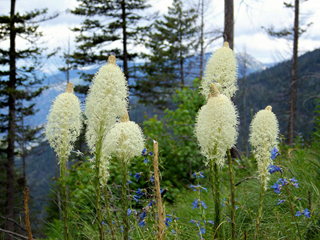
Glase, Terry
Xerophyllum tenax
Xerophyllum tenax (Pursh) Nutt.
Common Beargrass, Western Turkeybeard, Bear Lily, Pine Lily, Elk Grass, Squaw Grass, Beargrass, Turkeybeard
Liliaceae (Lily Family)
Synonym(s): Helonias tenax
USDA Symbol: XETE
USDA Native Status: L48 (N), CAN (N)
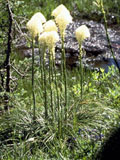
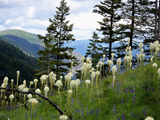
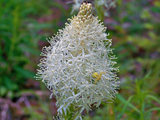
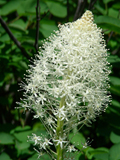
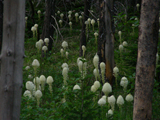
Western Turkeybeard or Beargrass makes a fountain of curved, rigid, grass-like, evergreen leaves, to 3 ft. tall, which are attractive without flowers. The central flower stalk rises a foot or more above the leaves and bears a dense plume of hundreds of creamy-white flowers. At the top of a stout stalk that grows from a massive bunch of basal leaves bloom many tiny flowers in a dense, broad, white raceme.
Native Americans used the leaves to weave garments and baskets and ate the roasted rootstock.
Plant Characteristics
Duration: PerennialHabit: Herb
Leaf Retention: Evergreen
Leaf Complexity: Simple
Fruit Type: Capsule
Size Notes: Up to about 6 feet tall when flowering.
Leaf: Green.
Bloom Information
Bloom Color: WhiteBloom Time: Mar , Apr , May , Jun , Jul , Aug
Distribution
USA: CA , ID , MT , OR , WA , WYCanada: AB , BC
Native Distribution: Coast Ranges and interior mts. from n. CA to B.C.; also Rocky Mts. of MT, WY & ID
Native Habitat: Open woods, dry slopes & ridges below 6000 ft.
Growing Conditions
Water Use: LowLight Requirement: Sun
CaCO3 Tolerance: Low
Soil Description: Variable.
Conditions Comments: Beargrass is a pioneer species in some habitats and disappears after taller plants shade it out. It is not a reliable bloomer in a garden setting but the leaves are attractive. In nature, beargrass flowers profusely the season after a fire. After flowering, the leafy tuft supporting the flower stalk dies, but young offset clumps will have already formed to replace the old.
Benefit
Use Wildlife: Rocky Mt. goats eat this plant in winter. The tough leaves, however, are unpalatable to all other grazers.Conspicuous Flowers: yes
Propagation
Description: Sow treated seeds. Seedlings take several years to flower. Offsets may be used as a faster source of new plants.Seed Treatment: Soak in distilled water 24 hours and stratify 4 months in vermiculite. Remove germinating seeds at weekly interval. A burn treatment has also given good results.
Commercially Avail: yes
Find Seed or Plants
Find seed sources for this species at the Native Seed Network.
View propagation protocol from Native Plants Network.
National Wetland Indicator Status
| Region: | AGCP | AK | AW | CB | EMP | GP | HI | MW | NCNE | WMVE |
| Status: | FACU |
From the National Organizations Directory
According to the species list provided by Affiliate Organizations, this plant is on display at the following locations:Santa Barbara Botanic Garden - Santa Barbara, CA
Native Seed Network - Corvallis, OR
Web Reference
Webref 38 - Flora of North America (2019) Missouri Botanical Garden, St. Louis, MO & Harvard University Herbaria, Cambridge, MA.Webref 23 - Southwest Environmental Information Network (2009) SEINet - Arizona Chapter
Additional resources
USDA: Find Xerophyllum tenax in USDA PlantsFNA: Find Xerophyllum tenax in the Flora of North America (if available)
Google: Search Google for Xerophyllum tenax
Metadata
Record Modified: 2023-04-12Research By: TWC Staff