Native Plants

Plant Database
Search for native plants by scientific name, common name or family. If you are not sure what you are looking for, try the Combination Search or our Recommended Species lists.
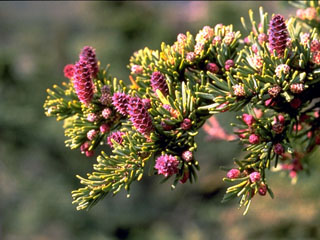
Weyand, Phyllis
Tsuga mertensiana
Tsuga mertensiana (Bong.) Carrière
Mountain Hemlock
Pinaceae (Pine Family)
Synonym(s):
USDA Symbol: TSME
USDA Native Status: L48 (N), AK (N), CAN (N)
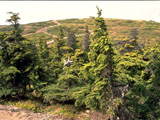
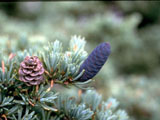
Mountain hemlock, an evergreen tree, grows 15-150 ft. tall in the wild, but is usually 20-60 ft. in cultivation. It has red-brown, scaly bark, and a slender, pyramidal to irregular crown. The central leader is the most droopy of all hemlocks, often making a 180 degree bend and pointing at the ground. Slim branchlets form graceful, pendent masses of delicate foliage. Needles are atypically round and are swept forward adding to the slender appearance of the branches. Cones are closed for most of their life and range in color from brilliant purple to lime-green or red. Tree with tapering trunk, conical crown of slender horizontal or drooping branches, and very slender, curved, drooping leader; a prostrate shrub at timberline.
Mountain Hemlock is a characteristic species of high mountains, varying greatly in size from a large tree at low altitudes to a dwarf, creeping shrub at timberline. Hemlock groves provide cover, nesting sites, and seeds for birds, as well as foliage for mountain goats and other hoofed browsers. This species honors its discoverer, Karl H. Mertens (1796-1830), the German naturalist.
Plant Characteristics
Duration: PerennialHabit: Tree
Leaf Retention: Evergreen
Leaf Complexity: Simple
Breeding System: Flowers Unisexual , Monoecious
Fruit Type: Cone
Size Notes: Up to about 150 feet tall. Trunk to about 5 feet in diameter.
Leaf: Green
Bloom Information
Bloom Color: Yellow , Green , BrownBloom Time: Jun , Jul
Distribution
USA: AK , CA , ID , MT , NV , OR , WACanada: BC
Native Distribution: Mts. from s. AK to c. CA & n.w. MT
Native Habitat: Moist, rich, wooded, subalpine slopes; 6000-11,000 ft.
Growing Conditions
Water Use: HighLight Requirement: Sun , Part Shade , Shade
Soil Moisture: Moist
CaCO3 Tolerance: Low
Drought Tolerance: High
Soil Description: Cool, moist soils.
Conditions Comments: The extremely slow-growing mountain hemlock is good for a small garden. It is not tolerant of pollution, extreme heat or southern sunshine, but adapts to a variety of soils and habitats including harsh, dry, windy sites.
Propagation
Description: Layering has proven successful, as has propagation by seed and cuttings. Cuttings must be treated and kept under mist.Seed Collection: Cones mature in one season. Seeds are of short viability.
Seed Treatment: A 2-4 month stratification at 40 degrees hastens germination.
Commercially Avail: yes
Find Seed or Plants
View propagation protocol from Native Plants Network.
National Wetland Indicator Status
| Region: | AGCP | AK | AW | CB | EMP | GP | HI | MW | NCNE | WMVE |
| Status: | FAC | FACU | FACU |
Web Reference
Webref 3 - Flora of North America (2014) Missouri Botanical Garden, St. Louis, MO & Harvard University Herbaria, Cambridge, MA.Additional resources
USDA: Find Tsuga mertensiana in USDA PlantsFNA: Find Tsuga mertensiana in the Flora of North America (if available)
Google: Search Google for Tsuga mertensiana
Metadata
Record Modified: 2022-09-26Research By: TWC Staff