Native Plants

Plant Database
Search for native plants by scientific name, common name or family. If you are not sure what you are looking for, try the Combination Search or our Recommended Species lists.
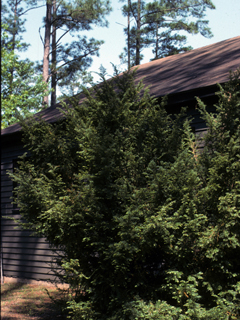
Wasowski, Sally and Andy
Taxus floridana
Taxus floridana Nutt. ex Chapm.
Florida Yew
Taxaceae (Yew Family)
Synonym(s): Taxus canadensis ssp. floridana, Taxus globosa var. floridana
USDA Symbol: TAFL
USDA Native Status: L48 (N)
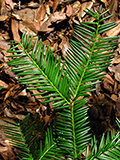
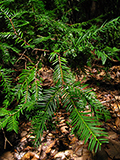
Florida Yew is an evergreen shrub or small tree, rarely to 25 ft (7.6 m) and usually less than 15 ft (4.6 m) tall. It has numerous spreading, horizontal branches that give it a bushy appearance. The leaves are needle-like and flat, about 1 in (2.5 cm) long and grow in two horizontal ranks on opposite sides of the twigs. The bark is purplish-brown, smooth on young stems and separating into thin irregular scales on older branches. Florida Yew is dioecious and in October the female plants bear oval, half-inch long fruits that consist of a single yellowish-brown seed partly enclosed in a fleshy red cup.
This rare species is threatened with extinction because of its very limited distribution. Torreya State Park near Bristol, Florida, preserves it as well as Florida Torreya (Torreya taxifolia Arn.), and it is in cultivation in botanical gardens. As with other yews, the seeds and foliage are poisonous and can be fatal when eaten by people or livestock. The red juicy cup around the seed, however, is apparently harmless. Canada Yew (Taxus canadensis Marsh.), is a related poisonous low shrub with shorter straight needles and similar seeds in a red cup. It ranges from southeastern Canada and northeastern United States west to Minnesota and south locally to Virginia and Tennessee.
Plant Characteristics
Duration: PerennialHabit: Tree
Leaf Retention: Evergreen
Breeding System: Flowers Unisexual , Dioecious
Fruit Type: Cone
Size Notes: Height rarely to 25 feet and usually less than 15 feet.
Bloom Information
Bloom Color: White , GreenBloom Time: Sep
Bloom Notes: Flowers inconspicuous.
Distribution
USA: FLNative Distribution: Local in NW. Florida in Gadsden and Liberty counties, mainly along eastern side of Apalachicola River; at less than 100' (30 m).
Native Habitat: Moist ravines in hardwood forests.
Growing Conditions
Light Requirement: Part Shade , ShadeDrought Tolerance: Medium
Benefit
Use Food: The red arils, in small amounts, are edible. The green seed is toxic.Use Medicinal: The bark of Florida yew contains the promising cancer-fighting compound taxol in amounts similar to Pacific yew (T. brevifolia). Taxol has been proven useful in treating breast cancer, ovarian cancer, some kinds of leukemia, and certain kidney diseases.
Warning: The seeds and foliage of all the yew species are extremely poisonous, and people have died from eating the seeds or drinking a tea made from the leaves.
Interesting Foliage: yes
Bibliography
Bibref 841 - Native Alternatives to Invasive Plants (2006) Burrell, C. C.Search More Titles in Bibliography
Web Reference
Webref 57 - Atlas of Florida Plants (2020) Institute for Systematic BotanyWebref 38 - Flora of North America (2019) Missouri Botanical Garden, St. Louis, MO & Harvard University Herbaria, Cambridge, MA.
Additional resources
USDA: Find Taxus floridana in USDA PlantsFNA: Find Taxus floridana in the Flora of North America (if available)
Google: Search Google for Taxus floridana
Metadata
Record Modified: 2023-05-23Research By: TWC Staff