Native Plants

Plant Database
Search for native plants by scientific name, common name or family. If you are not sure what you are looking for, try the Combination Search or our Recommended Species lists.
Bransford, W.D. and Dolphia
Silene laciniata
Silene laciniata Cav.
Cardinal Catchfly, Southern Indian Pink, Mexican Campion, Catchfly
Caryophyllaceae (Pink Family)
Synonym(s):
USDA Symbol: SILA2
USDA Native Status: L48 (N)
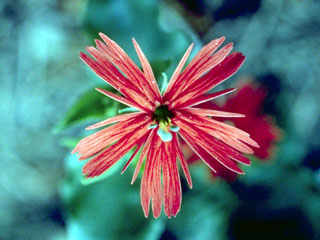
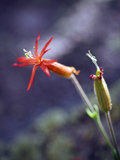
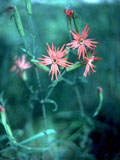
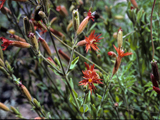
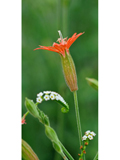
Cardinal Catchfly or Southern Indian Pink’s one to several, 1-4 ft. stems are slender and weak, often leaning against other vegetation. Showy, brilliant-red, tubular flowers, with five jagged petals, occur at branch ends. Leaves are densely covered with sticky hairs.
S. laciniata ssp. major is the form occuring in California. This subspecies has been divided into two varieties: var. angustifolia for plants near the coast and var. latifolia for interior plants. Subspecies greggii occurs in Arizona, New Mexico, and Texas. The flowers attract hummingbirds.

Plant Characteristics
Duration: PerennialHabit: Herb
Leaf Complexity: Simple
Fruit Type: Capsule
Size Notes: Up to about 4 feet tall.
Bloom Information
Bloom Color: RedBloom Time: May , Jun , Jul , Aug
Distribution
USA: AZ , CA , NM , TXNative Distribution: W. TX to c. CA, s. to Mex.
Native Habitat: Pine forests; grassy or brushy slopes
Growing Conditions
Light Requirement: Part ShadeSoil Description: Rich, gravelly soils.
Conditions Comments: S. laciniata ssp. major is the form occuring in CA. This ssp. has been divided into two varieties: var. angustifolia for plants near the coast and var. latifolia for interior plants. The typical S. laciniata occurs in the Mex. Cordillera. Stems can be cut back just after flowering to encourage new growth later.
Benefit
Use Wildlife: Flowers attract hummingbirds.Conspicuous Flowers: yes
Propagation
Description: Propagate with seeds, root sections or cuttings.Seed Treatment: No treatment is required.
Commercially Avail: yes
Bibliography
Bibref 248 - Texas Wildflowers: A Field Guide (1984) Loughmiller, C. & L. LoughmillerBibref 328 - Wildflowers of Texas (2003) Ajilvsgi, Geyata.
Search More Titles in Bibliography
Web Reference
Webref 30 - Calflora (2018) CalfloraWebref 38 - Flora of North America (2019) Missouri Botanical Garden, St. Louis, MO & Harvard University Herbaria, Cambridge, MA.
Webref 23 - Southwest Environmental Information Network (2009) SEINet - Arizona Chapter
Additional resources
USDA: Find Silene laciniata in USDA PlantsFNA: Find Silene laciniata in the Flora of North America (if available)
Google: Search Google for Silene laciniata
Metadata
Record Modified: 2023-02-27Research By: TWC Staff