Native Plants

Plant Database
Search for native plants by scientific name, common name or family. If you are not sure what you are looking for, try the Combination Search or our Recommended Species lists.
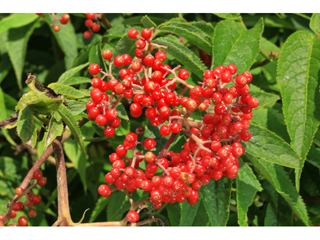
Cressler, Alan
Sambucus racemosa var. racemosa
Sambucus racemosa L. var. racemosa
Red Elderberry, Scarlet Elder, Red-berried Elder
Caprifoliaceae (Honeysuckle Family)
Synonym(s): Sambucus callicarpa, Sambucus microbotrys, Sambucus pubens, Sambucus pubens var. arborescens, Sambucus racemosa ssp. pubens, Sambucus racemosa var. arborescens, Sambucus racemosa var. laciniata, Sambucus racemosa var. leucocarpa, Sambucus racemosa var. microbotrys, Sambucus racemosa var. pubens
USDA Symbol: SARAR3
USDA Native Status: L48 (N), AK (N), CAN (N)
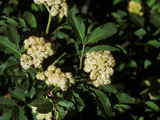
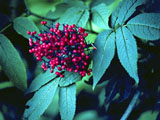
A globular shrub, 10-20 ft. tall, with tightly clustered basal stems. Upright branches become arching with age. Pinnately compound leaves. Small white flowers in conical spikes are followed by clusters of pea-sized, red berries.
The red fruit, inedible when raw and with a disagreeably bitter taste, can be made into wine and is also eaten by birds and mammals. There is much disagreement in the literature over the classification of Sambucus species. Several former species are now considered part of the subspecies Sambucus racemosa var. racemosa, including S. callicarpa and S. pubens.
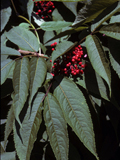
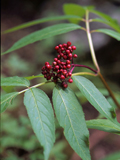
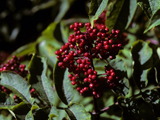
Plant Characteristics
Duration: PerennialHabit: Shrub
Leaf Retention: Deciduous
Fruit Type: Berry
Size Notes: Up to about 20 feet tall.
Leaf: Green
Autumn Foliage: yes
Fruit: Red
Bloom Information
Bloom Color: WhiteBloom Time: May , Jun , Jul , Aug
Distribution
USA: AK , AZ , CA , CO , CT , GA , IA , ID , IL , IN , KY , MA , MD , ME , MI , MN , MO , MT , NC , ND , NH , NJ , NM , NV , NY , OH , OR , PA , RI , SD , TN , UT , VA , VT , WA , WI , WV , WYCanada: AB , BC , MB , NB , NS , ON , PE , QC , SK , YT
Native Habitat: Rich or rocky woods; slopes; moist cliffs & ravines
Growing Conditions
Water Use: HighLight Requirement: Shade
Soil Moisture: Moist
Soil pH: Circumneutral (pH 6.8-7.2)
CaCO3 Tolerance: Medium
Soil Description: Rocky soils.
Conditions Comments: One of the earliest native shrubs in bloom. Fast-growing and short-lived.
Benefit
Use Wildlife: Very high. Birds eat berries.Use Food: Though many people think (incorrectly) that the fruit is poisonous, it was eaten widely by British Columbia First Peoples. Clusters of berries were gathered in July and August. Berries were detached back at camp and cooked overnight in steaming pits or boiled in redcedar boxes. Berries were placed over fires on skunk cabbage leaves and dried into cakes for later use. To improve the flavour, red elderberries were mixed with other kinds of berries. Recently people mix the berries with sugar and make wine jelly or jam.
Use Other: Note that roots, stems, bark, leaves, flowers and unripe fruit contain poisonous alkaloids and other substances that may cause nausea, vomiting and diarrhea. Medicinal tea from the plant may cause poisoning. Children have been poisoned when they used the hollowed out stems for peashooters.
Warning: POISONOUS PARTS: All parts. Low toxicity if eaten, not edible. Symptoms include nausea, vomiting, diarrhea, coma. Toxic Principle: Cyanogenic glycoside and alkaloid.
Conspicuous Flowers: yes
Attracts: Birds
Value to Beneficial Insects
Provides Nesting Materials/Structure for Native BeesSupports Conservation Biological Control
This information was provided by the Pollinator Program at The Xerces Society for Invertebrate Conservation.
Propagation
Description: Easily started from cuttings. May also be propagated by treated seed.Seed Collection: Collect fruits by stripping or cutting from the branches. Fruits may be dried or macerated and the seeds extracted.
Seed Treatment: Seed must be cold-moist stratified for two months. This treatment may be preceded by a 10-15 minute soak in H2SO4.
Commercially Avail: yes
Find Seed or Plants
Find seed sources for this species at the Native Seed Network.
From the National Organizations Directory
According to the species list provided by Affiliate Organizations, this plant is on display at the following locations:Santa Barbara Botanic Garden - Santa Barbara, CA
Delaware Nature Society - Hockessin, DE
Native Seed Network - Corvallis, OR
Mt. Cuba Center - Hockessin, DE
Web Reference
Webref 30 - Calflora (2018) CalfloraWebref 37 - Calscape (2019) California Native Plant Society
Webref 23 - Southwest Environmental Information Network (2009) SEINet - Arizona Chapter
Additional resources
USDA: Find Sambucus racemosa var. racemosa in USDA PlantsFNA: Find Sambucus racemosa var. racemosa in the Flora of North America (if available)
Google: Search Google for Sambucus racemosa var. racemosa
Metadata
Record Modified: 2022-10-21Research By: TWC Staff