Native Plants

Plant Database
Search for native plants by scientific name, common name or family. If you are not sure what you are looking for, try the Combination Search or our Recommended Species lists.
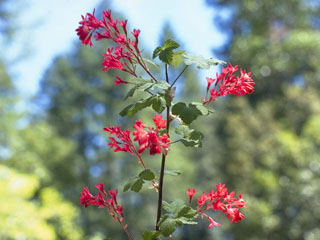
Bransford, W.D. and Dolphia
Ribes sanguineum
Ribes sanguineum Pursh
Redflower Currant, Blood Currant, Pink-flowered Currant, Red Flowering Currant
Grossulariaceae (Currant Family)
Synonym(s):
USDA Symbol: RISA
USDA Native Status: L48 (N), CAN (N)
Blood currant is an erect, 4-12 ft., deciduous shrub with many upright stems from the base. On older twigs the dark-green, lobed leaves are clustered on short, lateral spurs. The stiffly erect racemes of pale-pink to dark-red flowers occur along the length of the stems. Fruits are bloomy, bluish-black. This is a variable species, varying most notably in flower color.

Plant Characteristics
Duration: PerennialHabit: Shrub
Leaf Retention: Deciduous
Leaf Arrangement: Alternate
Leaf Complexity: Simple
Breeding System: Flowers Bisexual
Fruit Type: Berry
Size Notes: Up to about 12 feet tall.
Leaf: Green
Fruit: Black, Blue
Bloom Information
Bloom Color: White , Red , PinkBloom Time: Jan , Feb , Mar , Apr , May , Jun , Jul
Distribution
USA: CA , ID , OR , WACanada: BC
Native Distribution: CA Coast Ranges to B.C. & Benewah Co, ID
Native Habitat: Open or partly shady places below 2000 ft.
Growing Conditions
Water Use: MediumLight Requirement: Sun , Part Shade , Shade
Soil Moisture: Dry , Moist
CaCO3 Tolerance: Medium
Soil Description: Moist to drier, well-drained soils.
Conditions Comments: Fairly adaptable.
Benefit
Use Wildlife: A nectar source for hummingbirds, butterflies and bees.Conspicuous Flowers: yes
Fragrant Foliage: yes
Attracts: Hummingbirds
Value to Beneficial Insects
Special Value to Native BeesThis information was provided by the Pollinator Program at The Xerces Society for Invertebrate Conservation.
Propagation
Description: Take softwood cuttings in June or July. These root well when treated with hormone and placed under mist. Seeds may be fall sown or stratified. Hardwood cuttings, taken in fall are also used. Currants are easily layered as well.Seed Collection: Seeds need to be picked or stripped as soon as they are ripe to lessen losses to birds. Maceration and flotation can be used to extract the seeds.
Seed Treatment: Stratify three months at 32-36 degrees.
Commercially Avail: yes
Find Seed or Plants
View propagation protocol from Native Plants Network.
National Wetland Indicator Status
| Region: | AGCP | AK | AW | CB | EMP | GP | HI | MW | NCNE | WMVE |
| Status: | FACU |
Web Reference
Webref 30 - Calflora (2018) CalfloraWebref 38 - Flora of North America (2019) Missouri Botanical Garden, St. Louis, MO & Harvard University Herbaria, Cambridge, MA.
Webref 23 - Southwest Environmental Information Network (2009) SEINet - Arizona Chapter
Additional resources
USDA: Find Ribes sanguineum in USDA PlantsFNA: Find Ribes sanguineum in the Flora of North America (if available)
Google: Search Google for Ribes sanguineum
Metadata
Record Modified: 2022-10-20Research By: TWC Staff