Native Plants

Plant Database
Search for native plants by scientific name, common name or family. If you are not sure what you are looking for, try the Combination Search or our Recommended Species lists.
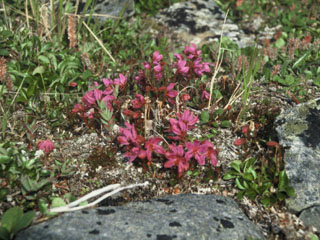
Mininberg, David T.
Rhododendron lapponicum
Rhododendron lapponicum (L.) Wahlenb.
Lapland Rosebay, Lapland Rhododendron
Ericaceae (Heath Family)
Synonym(s):
USDA Symbol: RHLA2
USDA Native Status: L48 (N), AK (N), CAN (N), GL (N)
A low, mat-forming, evergreen shrub with scaly twigs and few-flowered clusters of bell-shaped, pink to purple flowers. Lapland Rhododendron is an aromatic, mat-forming, dwarf shrub, often only 2 in. high; seldom more than 12 in. high. Close-ranked, oblong, dark-green leaves with rusty scales occur on the thick stems and knotty branches. One to five, fragrant flowers appear in terminal clusters at the ends of the branchlets.
This little, mat-forming shrub is one of the first showy alpine species to flower. It is found on the peaks of higher New England mountains such as Mount Washington, New Hampshire, and the Adirondack peaks of New York. It also grows in the Wisconsin Dells.
From the Image Gallery
Plant Characteristics
Duration: PerennialHabit: Shrub
Leaf Retention: Deciduous
Leaf Arrangement: Alternate
Leaf Complexity: Simple
Breeding System: Flowers Bisexual
Fruit Type: Capsule
Size Notes: Up to about 2 feet tall, often much shorter.
Bloom Information
Bloom Color: White , Pink , PurpleBloom Time: Mar , Apr , May , Jun , Jul , Aug , Sep
Bloom Notes: Rose pink to purple, sometimes white.
Distribution
USA: AK , CT , ME , NH , NY , WICanada: NL , NS , ON , QC
Native Distribution: Arctic & sub-arctic N. Am., s. to Mt. Katahdin, ME; Presidential Range, NH; Adirondacks, NY; & the Wisconsin Dells
Native Habitat: Limestone slopes; rocky tundra & barrens
Growing Conditions
Light Requirement: Part ShadeSoil Moisture: Dry
Soil pH: Alkaline (pH>7.2)
CaCO3 Tolerance: High
Soil Description: Dry, limey soil.
Benefit
Warning: Rhododendrons contain poisonous substances and should not be ingested by humans or animals. Honey made from flowers also may be toxic. POISONOUS PARTS: All parts. Highly Toxic, May be Fatal if eaten. Symptoms include salivation, watering of eyes and nose, abdominal pain, loss of energy, depression, nausea and vomiting, diarrhea, weakness, difficult breathing, progressive paralysis of arms and legs, coma. Toxic Principle: Andromedotoxin. (Poisonous Plants of N.C.)Conspicuous Flowers: yes
Value to Beneficial Insects
Special Value to Bumble BeesThis information was provided by the Pollinator Program at The Xerces Society for Invertebrate Conservation.
Propagation
Description: Sow seed in sandy loam and cover with a thin layer of sand. Can be transplanted as soon as the plant can be handled.Seed Treatment: No pretreatment is necessary.
Commercially Avail: yes
Find Seed or Plants
View propagation protocol from Native Plants Network.
National Wetland Indicator Status
| Region: | AGCP | AK | AW | CB | EMP | GP | HI | MW | NCNE | WMVE |
| Status: | FAC | FACW | FACW |
Web Reference
Webref 38 - Flora of North America (2019) Missouri Botanical Garden, St. Louis, MO & Harvard University Herbaria, Cambridge, MA.Webref 34 - Go Botany (2019) Native Plant Trust
Webref 23 - Southwest Environmental Information Network (2009) SEINet - Arizona Chapter
Additional resources
USDA: Find Rhododendron lapponicum in USDA PlantsFNA: Find Rhododendron lapponicum in the Flora of North America (if available)
Google: Search Google for Rhododendron lapponicum
Metadata
Record Modified: 2023-02-24Research By: TWC Staff