Native Plants

Plant Database
Search for native plants by scientific name, common name or family. If you are not sure what you are looking for, try the Combination Search or our Recommended Species lists.
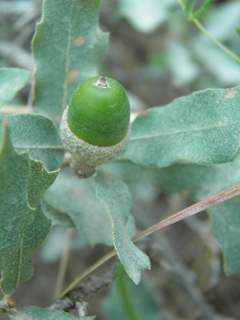
Anderson, Wynn
Quercus pungens
Quercus pungens Liebm.
Pungent Oak, Vasey Oak, Sandpaper Oak, Scrub Oak, Shin Oak, Scrub Live Oak, Encino
Fagaceae (Beech Family)
Synonym(s):
USDA Symbol: QUPU
USDA Native Status: L48 (N)
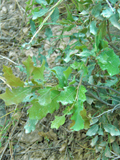
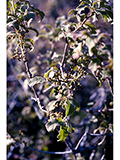
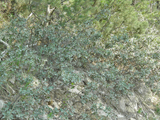
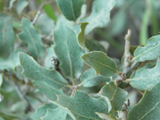
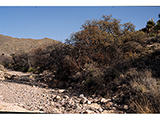
GROWTH FORM: shrub or small tree that grows to a height of 10 feet (3.1 m), evergreen or subevergreen. BARK: thin light brown, papery and flaky. TWIGS and BUDS: young gray twigs are pubescent and become smooth with age; buds are dark chestnut-brown with sparse pubescence. LEAVES: short petiole up to 3/8 inch (10 mm) in length; elliptic to oblong leaves, 3/8 - 3/4 inch (10 - 19 mm) wide, margins usually wavy and coarsely toothed or with spinose lobes; base rounded, apex acute or obtuse with mucronate tip; thick and leathery leaf blade, shinny yellowish-green with minute hairs presenting a rough texture above, dense pubescence mixed with stiff hairs beneath, sandpapery to the touch on both surfaces. ACORNS: annual; 1 - 2 sessile or short-stalked peduncle up to 1/8 inch (3 mm) long, chestnut-brown, top-shaped cup with gray pubescence, enclosing 1/4 of the nut; light brown, ovoid nut, up to 1/2 inch (13 mm) long.
The rough surface of the leaves is reflected in the common name. Sandpaper oak acorns provide food for birds, javelinas, mule deer, bighorn sheep, and various small mammals.
Plant Characteristics
Duration: PerennialHabit: Tree
Leaf Retention: Evergreen
Leaf Arrangement: Alternate
Leaf Complexity: Simple
Leaf Venation: Pinnate
Breeding System: Flowers Unisexual , Dioecious , Monoecious
Inflorescence: Catkin
Fruit Type: Nut
Size Notes: Up to about 10 feet tall.
Bloom Information
Bloom Color: RedBloom Time: Mar , Apr , May
Distribution
USA: AZ , NM , TXNative Distribution: Arizona east to Texas, and in northern Mexico (Durango, Chihuahua, Coahuila, Nuevo Leon, Tamaulipas, and San Luis Potosi).
Native Habitat: Mountains in the Lower Sonoran Life Zone associated with oak-juniper-pinyon dry woodlands.
Growing Conditions
Water Use: LowLight Requirement: Part Shade
Soil Moisture: Dry
Cold Tolerant: yes
Soil Description: Limestone-based, Caliche type, Sandy, Sandy Loam, Medium Loam, Clay Loam, Clay
Benefit
Use Ornamental: Aromatic, Attractive, Fall conspicuousUse Wildlife: Fruit-deer, Fruit-mammals, Fruit-rodents, Nesting site, Cover, Substrate-insectivorous birds, Fruit-birds.
Attracts: Butterflies
Larval Host: Horace's Duskywing butterfly.
From the National Organizations Directory
According to the species list provided by Affiliate Organizations, this plant is on display at the following locations:Texas Discovery Gardens - Dallas, TX
Bibliography
Bibref 766 - Dale Groom's Texas Gardening Guide (2002) Groom, D.Bibref 1134 - Field Guide to Native Oak Species of Eastern North America (2003) Stein, John D. and Denise Binion
Bibref 298 - Field Guide to Texas Trees (1999) Simpson, B.J.
Bibref 355 - Landscaping with Native Plants of Texas and the Southwest (1991) Miller, G. O.
Bibref 318 - Native Texas Plants: Landscaping Region by Region (2002) Wasowski, S. & A. Wasowski
Bibref 291 - Texas Wildscapes: Gardening for Wildlife (1999) Damude, N. & K.C. Bender
Bibref 297 - Trees of Central Texas (1984) Vines, Robert A.
Search More Titles in Bibliography
Web Reference
Webref 38 - Flora of North America (2019) Missouri Botanical Garden, St. Louis, MO & Harvard University Herbaria, Cambridge, MA.Additional resources
USDA: Find Quercus pungens in USDA PlantsFNA: Find Quercus pungens in the Flora of North America (if available)
Google: Search Google for Quercus pungens
Metadata
Record Modified: 2022-10-11Research By: TWC Staff