Native Plants

Plant Database
Search for native plants by scientific name, common name or family. If you are not sure what you are looking for, try the Combination Search or our Recommended Species lists.
Juett, William
Quercus havardii
Quercus havardii Rydb.
Havard Oak, Havard Shin-oak, Shinnery Oak
Fagaceae (Beech Family)
Synonym(s):
USDA Symbol: QUHA3
USDA Native Status: L48 (N)
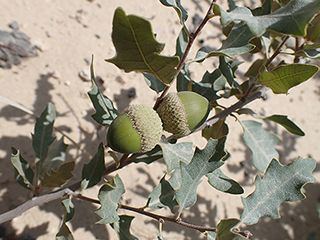
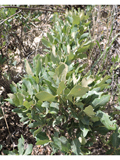
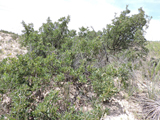
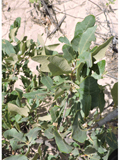
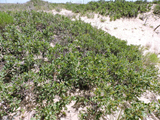
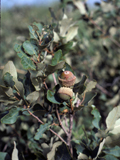
GROWTH FORM: rhizomatous shrub with a normal height of 3 feet (0.9 m) and exceptional speciments to 30 feet (9.1 m). BARK: papery, light gray. TWIGS and BUDS: brown pubescent twigs, becoming smooth with age; ovoid terminal buds are a dark reddish- brown. LEAVES: short petiole to 1⁄4 inch (6 mm); leaves are ovate or elliptical, 2 - 4 inches (51 - 101 mm) long, 3⁄4 - 2 inches (19 - 51 mm) wide; thick and with a rounded or cuneate base, margins generally have deep lobes with 2 - 3 rounded teeth on each side, apex rounded; upper surface shiny light green, lower surface has densely tawny tomentum.
This species was named for the U.S. Army surgeon and botanist, Valery Havard. Because Havard oak thrives in a harsh environment, it functions as a sand dune stabilizer and provides critical habitat for the endangered sand dune lizard (Sceloporus arenicolus). Although the acorns are an important food source for wildlife, the leaves are toxic to livestock. Use of herbicides to eradicate Havard oak has resulted in habitat loss and a drastic decline in sand dune lizard populations. The largest known Havard oak grows in Yoakum County, Texas.
Plant Characteristics
Duration: PerennialHabit: Shrub
Leaf Retention: Deciduous
Leaf Arrangement: Alternate
Leaf Complexity: Simple
Leaf Shape: Elliptic , Ovate
Leaf Venation: Pinnate
Leaf Margin: Dentate , Lobed
Leaf Base: Cuneate , Rounded
Breeding System: Flowers Unisexual , Monoecious
Inflorescence: Catkin
Fruit Type: Nut
Size Notes: Commonly 3-5 feet tall, often forming a spreading bush to 30 feet wide.
Fruit: Acorns annual; solitary or paired on a peduncle up to 3⁄8 inch (10 mm), a pubescent reddish- brown cup, which covers 1⁄3 - 1⁄2 of nut; brown, ovoid nut, 1 inch (25 mm) long.
Bloom Information
Bloom Color: GreenBloom Time: Mar , Apr , May
Distribution
USA: CO , NM , OK , TX , UTNative Distribution: New Mexico, Oklahoma, and Texas.
Native Habitat: Sandy soils and sand dunes; grows in areas devoid of almost all other trees.
Growing Conditions
Water Use: LowLight Requirement: Sun , Part Shade
Soil Moisture: Dry
Soil Description: Sandy
From the National Organizations Directory
According to the species list provided by Affiliate Organizations, this plant is on display at the following locations:Texas Parks and Wildlife Department - Austin, TX
Bibliography
Bibref 766 - Dale Groom's Texas Gardening Guide (2002) Groom, D.Bibref 1134 - Field Guide to Native Oak Species of Eastern North America (2003) Stein, John D. and Denise Binion
Bibref 318 - Native Texas Plants: Landscaping Region by Region (2002) Wasowski, S. & A. Wasowski
Bibref 291 - Texas Wildscapes: Gardening for Wildlife (1999) Damude, N. & K.C. Bender
Bibref 297 - Trees of Central Texas (1984) Vines, Robert A.
Search More Titles in Bibliography
Web Reference
Webref 38 - Flora of North America (2019) Missouri Botanical Garden, St. Louis, MO & Harvard University Herbaria, Cambridge, MA.Webref 23 - Southwest Environmental Information Network (2009) SEINet - Arizona Chapter
Additional resources
USDA: Find Quercus havardii in USDA PlantsFNA: Find Quercus havardii in the Flora of North America (if available)
Google: Search Google for Quercus havardii
Metadata
Record Modified: 2023-02-23Research By: TWC Staff