Native Plants

Plant Database
Search for native plants by scientific name, common name or family. If you are not sure what you are looking for, try the Combination Search or our Recommended Species lists.
Makin, Julie
Quercus ellipsoidalis
Quercus ellipsoidalis E.J. Hill
Northern Pin Oak, Black Oak, Hill's Oak
Fagaceae (Beech Family)
Synonym(s):
USDA Symbol: QUEL
USDA Native Status: L48 (N), CAN (N)
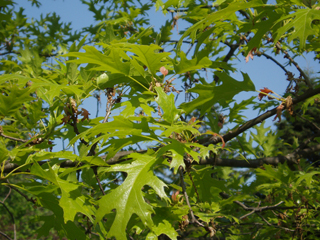
A medium-sized oak with many forked branches forming a crown 3/4 the height. Bark dark gray-brown with shallow fissures producing thin plates, inner bark orange in color. Twigs are first covered with hairs and then become smooth and reddish-brown; terminal buds are a shiny reddishbrown with scales ciliated along the margin, slightly angled in cross section. Leaves smooth petiole 3/4 - 2 inches (19 - 51 mm); leaves are elliptical, 2 3/4 - 5 1/8 inches (70 - 130 mm) long, and 2 - 4 inches (51 - 101 mm) wide, the base is truncate and the apex is acute, margins have 5 - 7 deep lobes extending more than 1/2 the distance to midrib with bristlepointed teeth, upper surface is a shiny light green and paler below with minute axillary tufts of tomentum along the midvein. Leaves a scarlet red in the fall. Dried leaves remain through winter.
Commonly this oak grows with the beautiful Pin oak (Quercus palustris), but it has none of the same elegance. Perhaps the easiest way to identify it is to discover its yellow inner bark, a trait which it shares with few other oaks. Northern pin oak is reduced to shrubby growth at the edge of its range. The largest known specimen grows in Bay Village, Cuyahoga County, Ohio.
Plant Characteristics
Duration: PerennialHabit: Tree
Leaf Retention: Deciduous
Leaf Arrangement: Alternate
Leaf Complexity: Simple
Leaf Shape: Elliptic
Leaf Venation: Pinnate
Leaf Margin: Lobed
Leaf Apex: Acute
Leaf Base: Truncate
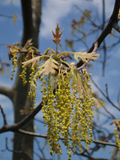
Breeding System: Flowers Unisexual , Monoecious
Inflorescence: Catkin
Fruit Type: Nut
Size Notes: Medium tree usually grows to about 60 feet tall, rarely to 130 feet tall.
Leaf: Upper surface is a shiny light green and paler below with minute axillary tufts of tomentum along the midvein.
Autumn Foliage: yes
Fruit: Acorns biennial; outer surface of cup is grayish-brown or reddish-brown and pubescent, inner surface is light brown and smooth, cup covers 1/3 - 1/2 of the nut; elliptical to ovoid nut 1/2 - 3/4 inches (13 - 19 mm) long, concentric apical rings are infreq
Bloom Information
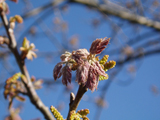
Bloom Color: Green , BrownBloom Time: Mar , Apr , May
Distribution
USA: IA , IL , IN , MI , MN , MO , ND , OH , WICanada: ON
Native Distribution: Occurs from Ontario south to northern Missouri, and east to Ohio and Michigan.
Native Habitat: Dry uplands; pine barrens; savannas. Dry sandy soils sites in the northern and central boreal forest region; found associated with species of pine, oak, hickory, aspen, and black cherry.
Growing Conditions
Light Requirement: SunSoil Moisture: Dry
Soil pH: Circumneutral (pH 6.8-7.2)
Soil Description: Dry, sandy soils.
Conditions Comments: The name refers to the ellipsoidal shape of the acorn. Slow-growing; long lived. Requires full sun. Susceptible to the deadly oak wilt. Do not prune in wilt-infested areas during the growing season. Prone to structural damage and decay.
Propagation
Description: Oaks are most often propagated from seed. No pretreatment is necessary. Plant immediately – outdoors or in deep containers to accomodate long initial taproot. Many oaks require cold temperatures to initiate shoot development. Protect outdoor beds withSeed Collection: Best quality acorns are picked or shaken from the tree. Collect when color has changed to brown. Best if sown immediately as acorns lose viability quickly in storage. Short-term storage in moist, shaded saw dust or sand. Acorns to be sown immediately can be soaked in hot water for 15 min. to prevent weevil infestation. Stored seed should be fumigated with methyl bromide.
Commercially Avail: yes
From the National Organizations Directory
According to the species list provided by Affiliate Organizations, this plant is on display at the following locations:Mt. Cuba Center - Hockessin, DE
Bibliography
Bibref 1134 - Field Guide to Native Oak Species of Eastern North America (2003) Stein, John D. and Denise BinionBibref 946 - Gardening with Prairie Plants: How to Create Beautiful Native Landscapes (2002) Wasowski, Sally
Search More Titles in Bibliography
Web Reference
Webref 3 - Flora of North America (2014) Missouri Botanical Garden, St. Louis, MO & Harvard University Herbaria, Cambridge, MA.Additional resources
USDA: Find Quercus ellipsoidalis in USDA PlantsFNA: Find Quercus ellipsoidalis in the Flora of North America (if available)
Google: Search Google for Quercus ellipsoidalis
Metadata
Record Modified: 2022-09-21Research By: TWC Staff