Native Plants

Plant Database
Search for native plants by scientific name, common name or family. If you are not sure what you are looking for, try the Combination Search or our Recommended Species lists.
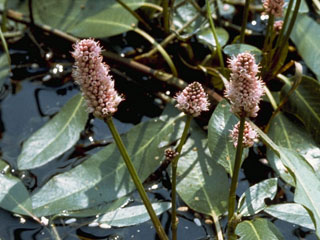
Bruso, George H.
Polygonum amphibium
Polygonum amphibium L.
Water Knotweed, Water Smartweed
Polygonaceae (Buckwheat Family)
Synonym(s):
USDA Symbol: POAM8
USDA Native Status: L48 (N), AK (N), CAN (N), SPM (N)
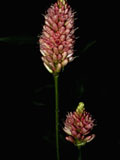
Freely rooting, long, prostrate stems growing across mud or in water and topped with erect, dense, narrowly egg-shaped, pink flower clusters.
This aquatic or wetland plant is rather showy when growing in colonies. The genus name is from the Greek poly ("many") and gona ("knee" or "joint"), as is the family name, and refers to the thickened joints of the stem where a sheath often surrounds the stem at the leaf axil. The genus includes the smartweeds, with tiny flowers in terminal spikes, and the knotweeds, with flower clusters in the leaf axils. This species also occurs in Eurasia. Its seeds provide food for waterfowl. Some authorities recognize two intergrading, environmentally variable varieties in the West. The variety stipulaceum has short oval flower clusters and is not especially aggressive; the pink flower masses of this variety are very attractive, but since the plants grow quickly, they can become an unwelcome weed in decorative ponds. The variety emersum has lanceolate leaves with narrowly tapering tips and slender flower clusters at least 1 1/2" (4 cm) long; once called P. coccineum, a separate species, this variety is aggressive to the point of being classified as a noxious weed.
Plant Characteristics
Duration: PerennialHabit: Herb
Fruit Type: Achene
Size Notes: Stems prostrate to ascending to erect, up to about 4 feet long in terrestrial plants, up to about 10 feet in some aquatic plants.
Leaf: Green
Bloom Information
Bloom Color: Red , PinkBloom Time: Jun , Jul , Aug , Sep
Distribution
USA: AK , AR , AZ , CA , CO , CT , DC , DE , IA , ID , IL , IN , KS , KY , LA , MA , MD , ME , MI , MN , MO , MS , MT , NC , ND , NE , NH , NJ , NM , NV , NY , OH , OK , OR , PA , RI , SC , SD , TN , TX , UT , VA , VT , WA , WI , WV , WYCanada: AB , BC , MB , NB , NL , NS , NT , ON , PE , QC , SK , YT
Native Distribution: Throughout North America, except Georgia, Alabama, Florida.
Native Habitat: Shorelines, wet prairies, swamps, ponds, and quiet streams, in mud or floating on still fresh water.
Growing Conditions
Water Use: HighLight Requirement: Sun
CaCO3 Tolerance: Medium
Web Reference
Webref 30 - Calflora (2018) CalfloraWebref 38 - Flora of North America (2019) Missouri Botanical Garden, St. Louis, MO & Harvard University Herbaria, Cambridge, MA.
Webref 23 - Southwest Environmental Information Network (2009) SEINet - Arizona Chapter
Additional resources
USDA: Find Polygonum amphibium in USDA PlantsFNA: Find Polygonum amphibium in the Flora of North America (if available)
Google: Search Google for Polygonum amphibium
Metadata
Record Modified: 2023-05-01Research By: TWC Staff