Native Plants

Plant Database
Search for native plants by scientific name, common name or family. If you are not sure what you are looking for, try the Combination Search or our Recommended Species lists.
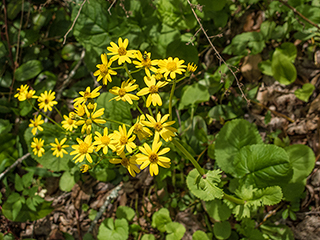
Brundage, Stephanie
Packera aurea
Packera aurea (L.) Á. Löve & D. Löve
Golden Groundsel, Golden Ragwort, Butterweed
Asteraceae (Aster Family)
Synonym(s): Senecio aureus, Senecio aureus var. aquilonius, Senecio aureus var. gracilis, Senecio aureus var. intercursus, Senecio gracilis
USDA Symbol: PAAU3
USDA Native Status: L48 (N), CAN (N), SPM (N)
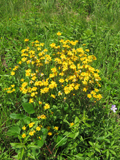
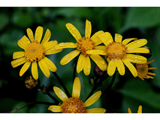
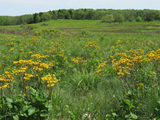
Golden groundsel’s stout, thick, basal offshoots creep horizontally and send up erect flowering stems 1-3 ft. in height. Flowers are deep golden-yellow, daisy-like and showy. Heart-shaped basal leaves are dark-green above and purple beneath. The stem leaves are lobed. The roots colonize and the plant can achieve a groundcover effect over time.
Of the 16 species in eastern North America, an upland forest species, Squaw Weed (P. obovata), has spatulate leaves tapering at the base. Westward, on dry bluffs and prairies, Prairie Ragwort (P. plattensis) has basal leaves woolly on the underside. Woolly Ragwort (P. tomentosa), found in open woods and fields along the coastal plain from New Jersey to Texas, has long, narrow, woolly basal leaves, especially when young.

Plant Characteristics
Duration: PerennialHabit: Herb
Leaf Retention: Evergreen
Inflorescence: Head
Size Notes: Leaves to 4 inches. Flowers on 2 to 3 foot stalks.
Leaf: Green above, purplish below.
Flower: Flower 1 inch across.
Fruit: White. Fruit is a cypsela (pl. cypselae). Though technically incorrect, the fruit is often referred to as an achene.
Bloom Information
Bloom Color: YellowBloom Time: Mar , Apr , May , Jun , Jul , Aug
Distribution
USA: AL , AR , CT , DC , DE , FL , GA , IA , IL , IN , KY , MA , MD , ME , MI , MN , MO , NC , NH , NJ , NY , OH , OK , PA , RI , SC , TN , TX , VA , VT , WI , WVCanada: MB , NB , NL , NS , ON , PE , QC
Native Distribution: Quebec to GA, w. to MN & LA. Eastern North America, Zones 3 to 9
Native Habitat: Meadows; boggy swales; low woods
Growing Conditions
Water Use: Medium , HighLight Requirement: Sun , Part Shade , Shade
Soil Moisture: Moist
Soil pH: Acidic (pH<6.8)
CaCO3 Tolerance: High
Heat Tolerant: yes
Soil Description: Rich, acidic soils.
Conditions Comments: Prefers moisture but also found growing in dryish areas. Tolerates seasonal flooding.
Benefit
Use Ornamental: When planted en masse, can lend a golden glow to the spring woodland landscape.Use Wildlife: Flowers attract bees.
Use Medicinal: Root and leaf tea used by Amerindians to treat delayed and irregular menses, childbirth complications, lung ailments, dysentery, difficult urination. (Foster & Duke) Toxic! Tea made of whole plant used for problems associated with the female reproductive tract and to speed childbirth. Substitute for ergot. (Weiner)
Warning: POISONOUS PARTS: Leaves, but only low toxicity if touched or ingested. Symptoms include liver toxicity, skin irritation following contact. Toxic Principle: Pyrrolizidine alkaloids. (Poisonous Plants of N.C.)
Conspicuous Flowers: yes
Propagation
Propagation Material: Root Division , SeedsDescription: Divide golden ragwort in the spring.
Seed Treatment: Seeds require 45 days cool-moist stratification. After stratification the seeds should be incubated at 70-80 degrees.
Commercially Avail: yes
Maintenance: For neatness, cut seed stalks to base after seed dispersal.
National Wetland Indicator Status
| Region: | AGCP | AK | AW | CB | EMP | GP | HI | MW | NCNE | WMVE |
| Status: | FACW | FACW | FACW | FACW | FACW |
From the National Organizations Directory
According to the species list provided by Affiliate Organizations, this plant is on display at the following locations:Delaware Nature Society - Hockessin, DE
NPSOT - Fredericksburg Chapter - Fredericksburg, TX
Mt. Cuba Center - Hockessin, DE
Bibliography
Bibref 1207 - Earth Medicine, Earth Food (1990) Michael A. WeinerBibref 417 - Field Guide to Medicinal Plants and Herbs of Eastern and Central North America (2000) Foster, S. & J. A. Duke
Bibref 1620 - Gardening with Native Plants of the South (Reprint Edition) (2009) Wasowski, S. with A. Wasowski
Bibref 841 - Native Alternatives to Invasive Plants (2006) Burrell, C. C.
Bibref 1294 - The Midwestern Native Garden: Native Alternatives to Nonnative Flowers and Plants An Illustrated Guide (2011) Adelman, Charlotte and Schwartz, Bernard L.
Search More Titles in Bibliography
Additional resources
USDA: Find Packera aurea in USDA PlantsFNA: Find Packera aurea in the Flora of North America (if available)
Google: Search Google for Packera aurea
Metadata
Record Modified: 2019-03-01Research By: TWC Staff