Native Plants

Plant Database
Search for native plants by scientific name, common name or family. If you are not sure what you are looking for, try the Combination Search or our Recommended Species lists.
Loughmiller, Campbell and Lynn
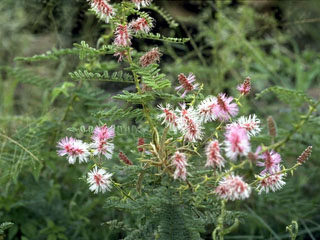
Mimosa dysocarpa
Mimosa dysocarpa Benth.
Velvetpod Mimosa, Velvet-pod Mimosa, Gatuno
Fabaceae (Pea Family)
Synonym(s): Mimosa dysocarpa var. wrightii
USDA Symbol: MIDY
USDA Native Status: L48 (N)
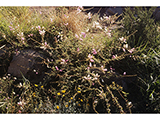
Velvet-pod mimosa is a deciduous shrub with markedly hairy leaves, twigs and pods. Usually 2 ft. tall, the shrub can reach 6 ft. with many branches spreading widely from the base. It has thorns in groups of 3 all along the 3-sided stem. The compound leaves are alternate, made up of 16-20 leaflets which, in turn, have several smaller leaflets. When touched, they close like those of the sensitive briar. Large numbers of small flowers grow along a short stem forming a 2-inch cylindrical plume, consisting of 20-30 buds that bloom at the same time. Flower heads are composed of 3-8 such plumes clustered on the end of each stem. They are slightly fragrant.

Plant Characteristics
Duration: PerennialHabit: Shrub
Leaf Retention: Deciduous
Leaf Arrangement: Alternate
Fruit Type: Legume
Size Notes: Up to about 6 feet tall.
Bloom Information
Bloom Color: PinkBloom Time: Jun , Jul , Aug , Sep , Oct
Distribution
USA: AZ , NM , TXNative Distribution: W. TX to AZ, s. to Mex.
Native Habitat: Arroyos; brushy hillsides; 3500 to 6500 ft.
Growing Conditions
Water Use: LowLight Requirement: Sun , Part Shade
Soil Moisture: Dry
Drought Tolerance: High
Soil Description: Rocky soils.
Conditions Comments: Fuzzy flowers up to 2 inches long are deep pink to magenta when open, fading to pink and then white as they age. This plant is extremely drought tolerant and can take reflected heat. The one to two inch fruit develops a a reddish brown velvety surface. Plant 2 to 3 feet apart in soil with excellent drainage. It is propagated by scarified seeds or semihardwood cuttings. Regular pruning encourages growth of more branches and flowers.
Benefit
Conspicuous Flowers: yesFragrant Flowers: yes
Attracts: Birds
Nectar Source: yes
From the National Organizations Directory
According to the species list provided by Affiliate Organizations, this plant is on display at the following locations:Sibley Nature Center - Midland, TX
NPSOT - Williamson County Chapter - Georgetown, TX
Bibliography
Bibref 318 - Native Texas Plants: Landscaping Region by Region (2002) Wasowski, S. & A. WasowskiBibref 248 - Texas Wildflowers: A Field Guide (1984) Loughmiller, C. & L. Loughmiller
Search More Titles in Bibliography
Research Literature
Reslit 2886 - Legumes of the United States. IV. Mimosa (1971) Duane IselyThis information was provided by the Florida WIldflower Foundation.
Search More Titles in Research Literature
Additional resources
USDA: Find Mimosa dysocarpa in USDA PlantsFNA: Find Mimosa dysocarpa in the Flora of North America (if available)
Google: Search Google for Mimosa dysocarpa
Metadata
Record Modified: 2009-04-23Research By: DEW, JSC