Native Plants

Plant Database
Search for native plants by scientific name, common name or family. If you are not sure what you are looking for, try the Combination Search or our Recommended Species lists.
Smith, R.W.
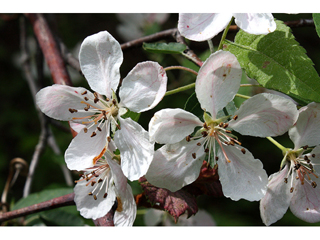
Malus coronaria
Malus coronaria (L.) Mill.
Sweet Crabapple, American Crab
Rosaceae (Rose Family)
Synonym(s): Malus bracteata, Malus coronaria var. coronaria, Malus coronaria var. dasycalyx, Malus coronaria var. elongata, Malus coronaria var. lancifolia, Malus glabrata, Malus glaucescens, Malus lancifolia, Pyrus bracteata, Pyrus coronaria, Pyrus coronaria var. dasycalyx, Pyrus coronaria var. elongata, Pyrus coronaria var. lancifolia, Pyrus glaucescens, Pyrus lancifolia
USDA Symbol: MACO5
USDA Native Status: L48 (N), CAN (N)
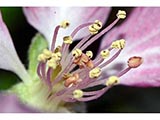
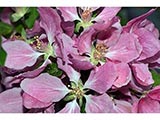
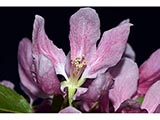
A 20-30 ft. tree with a short trunk and wide-spreading head. Flowers are white, tinged with rose. Yellow-green fruit is not showy by ornamental standards.
The common crabapple of the Ohio Valley, it is sometimes planted as an ornamental. Double-flowered varieties have a greater number of larger and deeper pink flowers. The fruit can be made into preserves and cider.


Plant Characteristics
Duration: PerennialHabit: Tree
Leaf Retention: Deciduous
Fruit Type: Pome
Size Notes: Up to about 30 feet tall.
Autumn Foliage: yes
Fruit: Green
Bloom Information
Bloom Color: White , PinkBloom Time: Apr , May , Jun
Distribution
USA: AL , AR , DC , DE , GA , IL , IN , KS , KY , LA , MD , MI , MO , NC , NJ , NY , OH , PA , SC , TN , VA , WI , WV , WYCanada: ON
Native Distribution: C. NY to s. WI, s. to DE, upland NC, GA & TN & n.e. AR
Native Habitat: Stream banks; open woods; woodland edges.
Growing Conditions
Light Requirement: Part ShadeSoil Moisture: Moist
Soil Description: Moist soils.
Conditions Comments: Very susceptible to rust.
Benefit
Use Wildlife: Crabapple thickets provide nesting sites, shelter, and food for large and small birds.Conspicuous Flowers: yes
Attracts: Birds
Value to Beneficial Insects
Special Value to Native BeesSpecial Value to Bumble Bees
Special Value to Honey Bees
This information was provided by the Pollinator Program at The Xerces Society for Invertebrate Conservation.
Propagation
Description: Interesting variations in flower color can be obtained by growing Malus spp. from seed.Seed Treatment: Seed dormancy can be overcome by cold stratification (37-41 degrees for 30-120 days).
Commercially Avail: yes
Web Reference
Webref 3 - Flora of North America (2014) Missouri Botanical Garden, St. Louis, MO & Harvard University Herbaria, Cambridge, MA.Webref 23 - Southwest Environmental Information Network (2009) SEINet - Arizona Chapter
Additional resources
USDA: Find Malus coronaria in USDA PlantsFNA: Find Malus coronaria in the Flora of North America (if available)
Google: Search Google for Malus coronaria
Metadata
Record Modified: 2023-05-10Research By: TWC Staff