Native Plants

Plant Database
Search for native plants by scientific name, common name or family. If you are not sure what you are looking for, try the Combination Search or our Recommended Species lists.
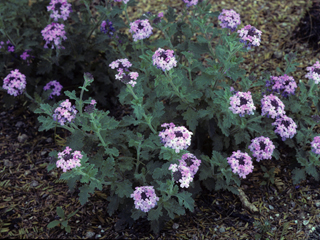
Wasowski, Sally and Andy
Glandularia gooddingii
Glandularia gooddingii (Briq.) Solbrig
Southwestern Mock Vervain, Pink Verbena, Southwestern Vervain, Goodding's Verbena, Mojave Verbena
Verbenaceae (Verbena Family)
Synonym(s): Verbena arizonica, Verbena gooddingii, Verbena gooddingii var. nepetifolia, Verbena verna, Verbena verna var. fissa
USDA Symbol: GLGO
USDA Native Status: L48 (N)
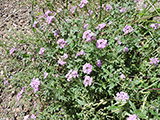
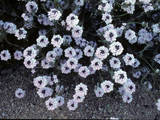
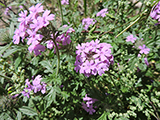
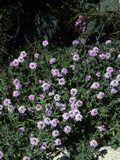
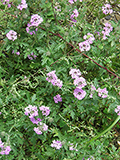
Both the stems and deeply divided, three-lobed leaves of this short-lived perennial are quite hairy. It is a spreading plant forming a low mat 3 ft. wide. Bright, pink-purple, tubular flowers are grouped together in rounded clusters atop several 6-18 in. stems. This plant is not as drought tolerant as its desert environment suggests. The flowering season is dependent on moisture. In some parts of its range, Pink Verbena may flower throughout the year.
This species is a member of the verbena family (family Verbenaceae), which includes about 75 genera and 3,000 species of herbs, shrubs, and trees, mostly of tropical and warm temperate regions. Among them, teak is a highly prized furniture wood, and Vervain, Lantana, Lippia or Frog Fruit, and Chase Tree or Vitex are grown as ornamentals.
Plant Characteristics
Duration: PerennialHabit: Herb
Fruit Type: Schizocarp
Size Notes: Up to about 18 inches tall.
Bloom Information
Bloom Color: Pink , PurpleBloom Time: Jan , Feb , Mar , Apr , May , Jun , Jul , Aug , Sep , Oct , Nov , Dec
Distribution
USA: AL , AZ , CA , CO , NM , NV , OK , TX , UTNative Distribution: E. Mohave Desert to s.w. UT, s. to Sonora in northwestern Mexico
Native Habitat: Washes; dry slopes; mesas; pinyon forests
Growing Conditions
Light Requirement: SunSoil Moisture: Dry
Soil Description: Well-drained, rocky soils.
Conditions Comments: This plant is not as drought tolerant as its desert environment suggests. The flowering season is dependent on moisture. In some parts of its range, pink verbena may flower as early as Feb. or as late as Oct. It is an ideal ground cover for hot, dry banks.
Propagation
Description: Plant untreated seed 1/8-1/4 in. deep in early spring, then thin plants to 8-12 in. apart before they bloom in summer.Seed Treatment: No chilling treatment is needed, but seeds germinate better if exposed to light.
Commercially Avail: yes
From the National Organizations Directory
According to the species list provided by Affiliate Organizations, this plant is on display at the following locations:Fredericksburg Nature Center - Fredericksburg, TX
Santa Barbara Botanic Garden - Santa Barbara, CA
Bibliography
Bibref 995 - Native Landscaping from El Paso to L.A. (2000) Wasowski, S. and A. WasowskiSearch More Titles in Bibliography
Web Reference
Webref 30 - Calflora (2018) CalfloraWebref 36 - Jepson eFlora (2019) The Jepson Herbarium, University of California, Berkeley
Webref 23 - Southwest Environmental Information Network (2009) SEINet - Arizona Chapter
Additional resources
USDA: Find Glandularia gooddingii in USDA PlantsFNA: Find Glandularia gooddingii in the Flora of North America (if available)
Google: Search Google for Glandularia gooddingii
Metadata
Record Modified: 2023-02-13Research By: TWC Staff