Native Plants

Plant Database
Search for native plants by scientific name, common name or family. If you are not sure what you are looking for, try the Combination Search or our Recommended Species lists.
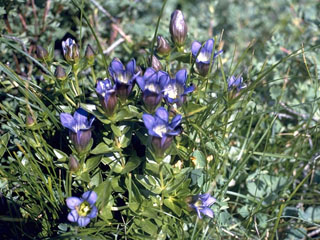
Bransford, W.D. and Dolphia
Gentiana calycosa
Gentiana calycosa Griseb.
Rainier Pleated Gentian
Gentianaceae (Gentian Family)
Synonym(s): Gentiana calycosa var. obtusiloba, Gentiana calycosa var. xantha, Pneumonanthe calycosa
USDA Symbol: GECA
USDA Native Status: L48 (N), CAN (N)
The clump of 4-18 inch stems is ever-increasing. Leaves are opposite, about 1 inch long, somewhat oval, and sessile to the stem. Several leafy stems in a clump bear at the top 1-3 blue, broadly funnel-shaped flowers. The light to deep blue, tubular flowers are held erect at the ends of the stems. The blue of the flower is sometimes mottled with green and the inner cup is pale.
Gentians are among the loveliest of mountain wildflowers and are rock-garden favorites. The genus honors King Gentius of Illyria, ruler of an ancient country on the east side of the Adriatic Sea, who is reputed to have discovered medicinal virtues in gentian plants.
Plant Characteristics
Duration: PerennialHabit: Herb
Fruit Type: Capsule
Size Notes: Stems decumbent, up to about 18 inches long.
Leaf: Green
Bloom Information
Bloom Color: White , Blue , PurpleBloom Time: Apr , May , Jun , Jul , Aug , Sep , Oct
Distribution
USA: CA , ID , MT , NV , OR , UT , WA , WYCanada: AB , BC
Native Distribution: B.C. to n. CA, e. to w. MT & WY
Native Habitat: Moist, alpine or subalpine meadows & stream banks
Growing Conditions
Water Use: MediumLight Requirement: Part Shade
Soil Moisture: Moist
CaCO3 Tolerance: Low
Soil Description: Moist, cool soil.
Conditions Comments: When using this gentian in a garden, conditions matching its wet, cold natural habitat must be met for any succuss.
Benefit
Warning: All parts of this plant, including the nectar, are poisonous if ingested. Sensitivity to a toxin varies with a person’s age, weight, physical condition, and individual susceptibility. Children are most vulnerable because of their curiosity and small size. Toxicity can vary in a plant according to season, the plant’s different parts, and its stage of growth; and plants can absorb toxic substances, such as herbicides, pesticides, and pollutants from the water, air, and soil.Conspicuous Flowers: yes
Value to Beneficial Insects
Special Value to Bumble BeesThis information was provided by the Pollinator Program at The Xerces Society for Invertebrate Conservation.
Find Seed or Plants
View propagation protocol from Native Plants Network.
National Wetland Indicator Status
| Region: | AGCP | AK | AW | CB | EMP | GP | HI | MW | NCNE | WMVE |
| Status: | FACW | FACW |
Web Reference
Webref 30 - Calflora (2018) CalfloraWebref 36 - Jepson eFlora (2019) The Jepson Herbarium, University of California, Berkeley
Webref 23 - Southwest Environmental Information Network (2009) SEINet - Arizona Chapter
Additional resources
USDA: Find Gentiana calycosa in USDA PlantsFNA: Find Gentiana calycosa in the Flora of North America (if available)
Google: Search Google for Gentiana calycosa
Metadata
Record Modified: 2023-04-04Research By: TWC Staff