Native Plants

Plant Database
Search for native plants by scientific name, common name or family. If you are not sure what you are looking for, try the Combination Search or our Recommended Species lists.
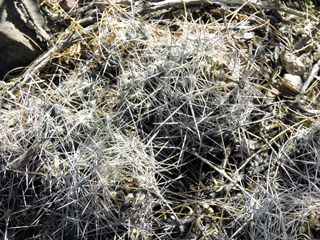
Anderson, Wynn
Coryphantha macromeris var. macromeris
Coryphantha macromeris (Engelm.) Lem. var. macromeris
Nipple Beehive Cactus, Big Needle Cactus, Big Nipple Cory-cactus, Dona Ana, Long Mamma
Cactaceae (Cactus Family)
Synonym(s): Mammillaria macromeris
USDA Symbol: COMAM2
USDA Native Status: L48 (N)
Plant Characteristics
Duration: PerennialHabit: Cactus/Succulent
Breeding System: Flowers Bisexual
Fruit Type: Berry
Size Notes: Plants profusely branched, ultimately forming low mats or hemispheric mounds to 100 cm diameter. (Webref 3).
Flower: Flowers apical or nearly so, 30-50(-60) x (30-)40-70 mm; outer tepals heavily fringed; inner tepals 20-25 per flower, bright rose-pink or magenta, often with darker midstripes and paler margins, 30-40 x 4.5-6 mm; outer filaments greenish white throughout or distally purplish pink; anthers bright yellow; stigma lobes 6-13, white or pale yellow, 3-6 mm. (Webref 3).
Fruit: Fruits berrylike, dark green, ovoid to obpyriform or ellipsoid, (10-)13-25(-30) x 12-18 mm; floral remnant strongly persistent. Seeds reddish brown, more or less comma-shaped to spheric, 1.2-1.5 mm, finely and weakly raised-reticulate. (Webref 3).
Bloom Information
Bloom Color: Pink , PurpleBloom Time: Feb , Mar , Apr , May , Jun , Jul , Aug , Sep
Bloom Notes: Bright rose-pink or magenta. (Webref 3).
Distribution
USA: NM , TXNative Distribution: Trans-Pecos Texas, New Mexico and Mexico.
Native Habitat: Chihuahuan desert scrub, Tamaulipan thorn scrub, nearly all substrates including nearly pure gypsum, gravelly soils, usually sandy alluvium or clay, rarely crevices or steep slopes; 30-1700(-2000) m. (Webref 3).
Growing Conditions
Water Use: LowLight Requirement: Sun , Part Shade
Soil Moisture: Dry
Soil pH: Alkaline (pH>7.2)
CaCO3 Tolerance: High
Drought Tolerance: High
Heat Tolerant: yes
Soil Description: Nearly all substrates including nearly pure gypsum, gravelly soils, usually sandy alluvium or clay. (Webref 3).
Bibliography
Bibref 293 - Manual of the Vascular Plants of Texas (1979) Correll, D. S. & M. C. JohnstonSearch More Titles in Bibliography
Web Reference
Webref 3 - Flora of North America (2014) Missouri Botanical Garden, St. Louis, MO & Harvard University Herbaria, Cambridge, MA.Additional resources
USDA: Find Coryphantha macromeris var. macromeris in USDA PlantsFNA: Find Coryphantha macromeris var. macromeris in the Flora of North America (if available)
Google: Search Google for Coryphantha macromeris var. macromeris
Metadata
Record Modified: 2021-03-12Research By: Joseph A. Marcus