Native Plants

Plant Database
Search for native plants by scientific name, common name or family. If you are not sure what you are looking for, try the Combination Search or our Recommended Species lists.
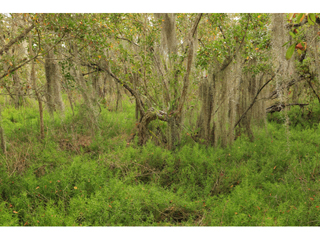
Cressler, Alan
Conocarpus erectus
Conocarpus erectus L.
Button Mangrove, Buttonwood
Combretaceae (Indian Almond Family)
Synonym(s): Conocarpus erectus var. sericeus
USDA Symbol: COER2
USDA Native Status: L48 (N), HI (I), PR (N), VI (N)
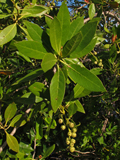
Spreading shrub to low-branching tree with narrow rounded crown; thicket-forming. Button Mangrove or Buttonwood occurs as an evergreen shrub or tree, growing to 60 ft. with a twisted trunk. The purplish-green, cone-like fruits are about 1/2 in. in diameter. They are preceded by clusters of whitish flowers. Button Mangrove has green leaves.
Plant Characteristics
Duration: PerennialHabit: Shrub
Leaf Retention: Evergreen
Fruit Type: Drupe
Size Notes: Up to about 60 feet tall.
Bloom Information
Bloom Color: WhiteBloom Time: Jan , Feb , Mar , Apr , May , Jun , Jul , Aug , Sep , Oct , Nov , Dec
Distribution
USA: FL , HINative Distribution: S. & c. FL
Native Habitat: Sandy, coastal shores, landward of the tidal mangrove zone
Growing Conditions
Light Requirement: SunSoil Moisture: Wet
Soil Description: Wet, sandy to drier, richer soils.
Conditions Comments: Buttonwood occupies the transition between saline and fresh water communities. The scaly-ridged bark provides an ideal substratum for the attachment of bromeliads and orchids. In the landscape, this is a good species for hedges. Ssp. sericea is less cold-hardy than the species.
Propagation
Description: Propagation by cuttings is relatively easy.Commercially Avail: yes
National Wetland Indicator Status
| Region: | AGCP | AK | AW | CB | EMP | GP | HI | MW | NCNE | WMVE |
| Status: | FACW | FACW | FACW | FACW |
Web Reference
Webref 38 - Flora of North America (2019) Missouri Botanical Garden, St. Louis, MO & Harvard University Herbaria, Cambridge, MA.Webref 23 - Southwest Environmental Information Network (2009) SEINet - Arizona Chapter
Research Literature
Reslit 606 - Ecology, production and use of mangrove, Conocarpus erectus L., in Barra de Tecoanapa (Guerrero, Mexico) (1999) C. T. Hernandez and G. D. EspinoReslit 985 - Ten new microsatellite markers for the buttonwood mangrove (Conocarpus erectus L., Combretaceae) (2008) A. Nettel, R. S. Dodd, J. A. Cid-Becerra and J. de...
Reslit 1317 - Stomatal conductance and gas exchange in four species of Caribbean mangroves exposed to ambient and increased CO2 (1998) S. C. Snedaker and R. J. Araujo
Reslit 1331 - Intense disturbance enhances plant susceptibility to herbivory: Natural and experimental evidence (2003) D. A. Spiller and A. A. Agrawal
Reslit 1995 - Egg distribution and sampling of Diaprepes abbreviatus (Coleoptera : Curculionidae) on silver buttonwood (2007) J. E. Pena, D. Amalin, A. Hunsberger and C. Mannio...
Reslit 2021 - Studies on Propagation and Implantation Characteristics of Conocarpus erectus L. (1978) D. Mizrachi and F. R. Pannier
Reslit 2034 - Survival of Diaprepes abbreviatus (Coleoptera: Curculionidae) Larvae on Green Buttonwood Trees in Flooded Marl Soil and Potting Medium (2010) C. G. Martin, C. M. Mannion and B. Schaffer
Reslit 2110 - Effect of root feeding by Diaprepes abbreviatus (Coleoptera : Curculionidae) larvae on leaf gas exchange and growth of three ornamental tree species (2006) A. P. Diaz, C. Mannion and B. Schaffer
Reslit 2381 - Leaf damage in island buttonwood, Conocarpus erectus: correlations with pubescence, island area, isolation and the distribution of major carnivores (1988) T. W. Schoener
Reslit 2471 - Polymorphic buttonwood: Effects of disturbance on resistance to herbivores in green and silver morphs of a Bahamian shrub (2004) A. A. Agrawal and D. A. Spiller
This information was provided by the Florida WIldflower Foundation.
Search More Titles in Research Literature
Additional resources
USDA: Find Conocarpus erectus in USDA PlantsFNA: Find Conocarpus erectus in the Flora of North America (if available)
Google: Search Google for Conocarpus erectus
Metadata
Record Modified: 2023-03-21Research By: TWC Staff