Native Plants

Plant Database
Search for native plants by scientific name, common name or family. If you are not sure what you are looking for, try the Combination Search or our Recommended Species lists.
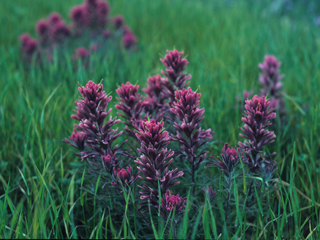
Wasowski, Sally and Andy
Castilleja purpurea var. purpurea
Castilleja purpurea (Nutt.) G. Don var. purpurea
Purple Paintbrush, Purple Prairie Painbrush, Prairie Paintbrush, Downy Indian Paintbrush
Scrophulariaceae (Figwort Family)
Synonym(s):
USDA Symbol: CAPUP5
USDA Native Status: L48 (N)
Castilleja purpurea var. purpurea, Purple Paintbrush, has the widest range of natural colors of any of the three varieties of its species, C. purpurea, usually some shade of purple, but occasionally also shades of red, orange, yellow, or white. Favoring grasslands with rocky limestone soils, it ranges from southwest Missouri southwest to central Texas. Like many paintbrushes, it is semi-parasitic on prairie grasses and is thus ideal for meadow and prairie plantings. It is a perennial.


Plant Characteristics
Duration: PerennialHabit: Herb
Leaf Arrangement: Alternate
Leaf Complexity: Simple
Leaf Shape: Lanceolate , Linear
Leaf Pubescence: Villose
Leaf Margin: Entire
Breeding System: Flowers Unisexual , Monoecious
Inflorescence: Spike
Fruit Type: Capsule
Size Notes: Usually 6-9 inches but can be twice that
Leaf: Green to grey-green
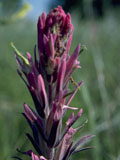
Flower: Spikes to 6 inches. Individual flowers within bracts 25-40 mm.
Bloom Information
Bloom Color: Red , PurpleBloom Time: Apr , May
Distribution
USA: KS , MO , OK , TXNative Distribution: Southwest Missouri through eastern Oklahoma to central Texas
Native Habitat: Rocky, limestone grasslands
Growing Conditions
Water Use: LowLight Requirement: Sun
Soil Moisture: Dry
Soil pH: Alkaline (pH>7.2)
Drought Tolerance: High
Heat Tolerant: yes
Soil Description: Rocky limestone outcrops preferred
Conditions Comments: Semi-parasitic on grass roots so prairies, meadows necessary.
Benefit
Use Ornamental: Vivid spring flowers for limestone prairies, meadows, and perennial gardens within its rangeUse Wildlife: Flowers attract insect pollinators and hummingbirds.
Conspicuous Flowers: yes
Attracts: Hummingbirds
Nectar Source: yes
Propagation
Propagation Material: SeedsCommercially Avail: yes
Maintenance: If plant appears to be in decline, plant a prairie grass near it, as it's semi-parasitic on grass roots.
Wildflower Center Seed Bank
LBJWC-MM-754 Collected 2010-07-14 in Hamilton County by Lady Bird Johnson Wildflower CenterBibliography
Bibref 293 - Manual of the Vascular Plants of Texas (1979) Correll, D. S. & M. C. JohnstonBibref 318 - Native Texas Plants: Landscaping Region by Region (2002) Wasowski, S. & A. Wasowski
Bibref 281 - Shinners & Mahler's Illustrated Flora of North Central Texas (1999) Diggs, G. M.; B. L. Lipscomb; B. O'Kennon; W. F...
Bibref 286 - Wildflowers of the Texas Hill Country (1989) Enquist, M.
Search More Titles in Bibliography
Additional resources
USDA: Find Castilleja purpurea var. purpurea in USDA PlantsFNA: Find Castilleja purpurea var. purpurea in the Flora of North America (if available)
Google: Search Google for Castilleja purpurea var. purpurea
Metadata
Record Modified: 2009-12-05Research By: TWC Staff, GDG