Native Plants

Plant Database
Search for native plants by scientific name, common name or family. If you are not sure what you are looking for, try the Combination Search or our Recommended Species lists.
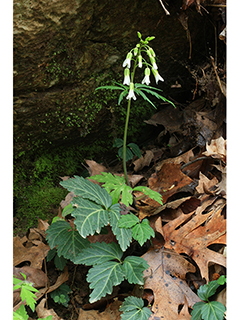
Cressler, Alan
Cardamine diphylla
Cardamine diphylla (Michx.) Alph. Wood
Crinkleroot, Two-leaved Toothwort, Two-leaf Toothwort
Brassicaceae (Mustard Family)
Synonym(s): Dentaria diphylla, Dentaria incisa
USDA Symbol: CADI10
USDA Native Status: L48 (N), CAN (N)
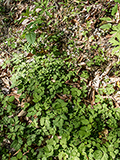
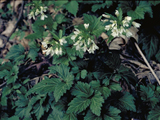
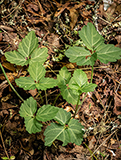
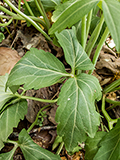
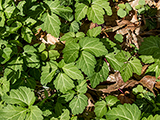
An upright, 8-16 in. perennial with paired leaves, each dissected so deeply as to appear compound. The leaves are palmately cut into 3-5 sections. The basal leaves, when present, arise from a rhizome. A loose cluster of white or light pink, four-petaled blossoms occur at the end of a stem rising above the leaves.
This plant grows in woods but does not tolerate the deep shade cast by evergreen trees.
Plant Characteristics
Duration: PerennialHabit: Herb
Fruit Type: Silique
Size Notes: Up to about 16 inches tall.
Bloom Information
Bloom Color: White , PinkBloom Time: Mar , Apr , May , Jun
Distribution
USA: AL , AR , CT , GA , IL , IN , KY , MA , MD , ME , MI , MO , MS , NC , NH , NJ , NY , OH , PA , SC , TN , VA , VT , WI , WVCanada: NB , NS , ON , PE
Native Distribution: N.S. to s. Ont. & WI, s. to SC & MS
Native Habitat: Rich, wooded slopes; alluvial woods
Growing Conditions
Light Requirement: Part Shade , ShadeSoil Moisture: Moist
Soil pH: Acidic (pH<6.8)
Soil Description: Humus-rich, acid soil.
Conditions Comments: A light, leafy wintercover is desireable. This plant does not tolerate the deep shade cast by evergreen trees.
Benefit
Use Wildlife: West Virginia White is a native butterfly species often mistaken for Cabbage White, an introduced species. Lays its eggs one by one on this plant and Dentaria laciniata, another toothwort.Attracts: Butterflies
Butterflies and Moths of North America (BAMONA)
|
West Virginia White (Pieris virginiensis)  Larval Host |
Propagation
Description: Can be easily multiplied by rootstock division when the plant is dormant. Be careful, as rhizomes are easily broken. Seeds should be sown on a moist, shaded seed bed immediately after collection. Expect the seedlings to flower in 3-4 years.Seed Collection: A long, slender pod splits open 4-5 weeks after the bloom period. To catch the seeds, collect the pods when the seeds have turned dark brown and allow the pods to dry and split in a paper bag. Seeds lose viability quickly in storage.
Commercially Avail: yes
National Wetland Indicator Status
| Region: | AGCP | AK | AW | CB | EMP | GP | HI | MW | NCNE | WMVE |
| Status: | UPL | FACU | FACU | FACU |
From the National Organizations Directory
According to the species list provided by Affiliate Organizations, this plant is on display at the following locations:Mt. Cuba Center - Hockessin, DE
Bibliography
Bibref 1186 - Field Guide to Moths of Eastern North America (2005) Covell, C.V., Jr.Bibref 1185 - Field Guide to Western Butterflies (Peterson Field Guides) (1999) Opler, P.A. and A.B. Wright
Bibref 1620 - Gardening with Native Plants of the South (Reprint Edition) (2009) Wasowski, S. with A. Wasowski
Bibref 1294 - The Midwestern Native Garden: Native Alternatives to Nonnative Flowers and Plants An Illustrated Guide (2011) Adelman, Charlotte and Schwartz, Bernard L.
Search More Titles in Bibliography
Web Reference
Webref 38 - Flora of North America (2019) Missouri Botanical Garden, St. Louis, MO & Harvard University Herbaria, Cambridge, MA.Webref 23 - Southwest Environmental Information Network (2009) SEINet - Arizona Chapter
Additional resources
USDA: Find Cardamine diphylla in USDA PlantsFNA: Find Cardamine diphylla in the Flora of North America (if available)
Google: Search Google for Cardamine diphylla
Metadata
Record Modified: 2022-12-21Research By: TWC Staff