Native Plants

Plant Database
Search for native plants by scientific name, common name or family. If you are not sure what you are looking for, try the Combination Search or our Recommended Species lists.
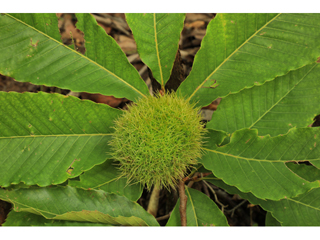
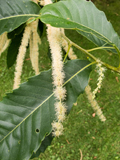
Cressler, Alan
Castanea dentata
Castanea dentata (Marshall) Borkh.
American Chestnut
Fagaceae (Beech Family)
Synonym(s): Castanea americana
USDA Symbol: CADE12
USDA Native Status: L48 (N), CAN (N)
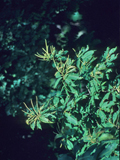
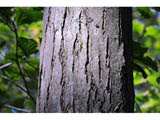
Formerly a large tree with a massive trunk and a broad, rounded, dense crown; now found mostly as small sprouts from base of long-dead trees.
American Chestnut is gone from the forests, a victim of the chestnut blight caused by an introduced fungus. This disease began in New York City in 1904, spread rapidly, and within 40 years had virtually wiped out this once abundant species. Fortunately, there is no threat of extinction; sprouts continue from roots until killed back by the blight, and cultivated trees grow in western states and other areas where the parasite is absent. Blight-resistant chestnuts such as hybrids between American and Chinese species are being developed for ornament, shade, and wildlife. The wood of this species was once the main domestic source of tannin, the edible chestnuts were a commercial crop, and the leaves were used in home medicines.

Plant Characteristics
Duration: PerennialHabit: Tree
Leaf Arrangement: Alternate
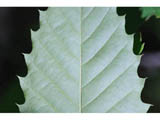
Leaf Complexity: Simple
Leaf Venation: Pinnate
Breeding System: Flowers Unisexual , Monoecious
Fruit Type: Nut
Size Notes: Up to about 100 feet tall.
Leaf: Yellow-Green
Fruit: Brown
Bloom Information
Bloom Color: WhiteBloom Time: Jun , Jul
Distribution
USA: AL , CT , DC , DE , FL , GA , IA , IL , IN , KY , LA , MA , MD , ME , MI , MO , MS , NC , NH , NJ , NY , OH , PA , RI , SC , TN , VA , VT , WI , WVCanada: ON
Native Distribution: Extreme s. Ontario east to Maine, south to sw. Georgia, west to Mississippi, north to Indiana; to 4000' (1219 m).
Native Habitat: Moist upland soils in mixed forests.
Growing Conditions
Water Use: MediumLight Requirement: Sun , Part Shade , Shade
Soil Moisture: Moist
Soil pH: Acidic (pH<6.8)
CaCO3 Tolerance: None
Benefit
Use Wildlife: Provides larval food for around 125 species of butterflies and moths.Use Food: Once the most important edible nut of eastern indigenous people.
Use Medicinal: This is Canada's only native chestnut. Settlers boiled the leaves to make a jelly for treating burns and sweaty feet. A tea of the bark was gargled to soothe inflamed tonsils, and it was swallowed (with honey) to cure whooping cough. (Kershaw)
Conspicuous Flowers: yes
Fragrant Flowers: yes
Larval Host: For circa 125 species of Lepidoptera.
Bibliography
Bibref 1198 - Bringing Nature Home: How Native Plants Sustain Wildlife in Our Gardens (2007) Tallamy, Douglas W.Bibref 1243 - The Southeastern Indians (1976) Hudson, Charles
Bibref 1258 - Trees of Ontario (2007) Kershaw, Linda
Search More Titles in Bibliography
Web Reference
Webref 38 - Flora of North America (2019) Missouri Botanical Garden, St. Louis, MO & Harvard University Herbaria, Cambridge, MA.Webref 23 - Southwest Environmental Information Network (2009) SEINet - Arizona Chapter
Additional resources
USDA: Find Castanea dentata in USDA PlantsFNA: Find Castanea dentata in the Flora of North America (if available)
Google: Search Google for Castanea dentata
Metadata
Record Modified: 2023-04-04Research By: TWC Staff