Native Plants

Plant Database
Search for native plants by scientific name, common name or family. If you are not sure what you are looking for, try the Combination Search or our Recommended Species lists.
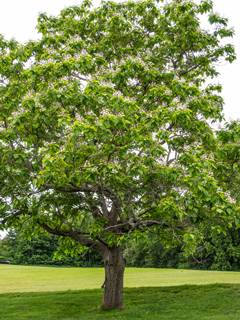
Brundage, Stephanie
Catalpa bignonioides
Catalpa bignonioides Walter
Southern Catalpa, Cigar Tree, Indian Bean
Bignoniaceae (Trumpet-Creeper Family)
Synonym(s): Catalpa catalpa
USDA Symbol: CABI8
USDA Native Status: L48 (N), CAN (I)
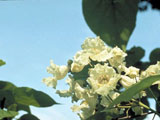
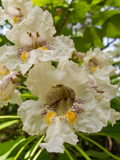
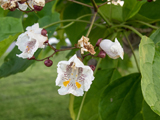
The catalpa tree reaches 25-40 ft. in height with an equal or greater spread. Short, crooked branches form a broad, irregular crown. Its heart-shaped leaves have prominent veins and are 6-12 inches long and half as wide. The petiole is almost as long as the leaf. Deciduous leaves are large, light-green and smooth. The flowers are in clusters of 10-20, each blossom on a short stem. They are white, 2-lipped, united at the base, opening into 5 ruffled, petal-like lobes; each flower is about 2 inches across. In the throat there are 2 large yellow spots and several smaller ones, several small purple stripes, and a number of tiny purple spots. Fruit a cigarlike pod.
The name Catalpa is a Muskogean name for the tree, while the specific name refers to a related vine with flowers of similar shape: Crossvine (Bignonia capreolata). Planted as a shade tree and an ornamental for the abundant showy flowers, cigar-like pods, and coarse foliage.

Plant Characteristics
Duration: PerennialHabit: Tree
Leaf Retention: Deciduous
Leaf Arrangement: Opposite , Whorled
Leaf Complexity: Simple
Leaf Shape: Ovate
Leaf Base: Cordate
Leaf Texture: Smooth
Breeding System: Flowers Bisexual
Fruit Type: Capsule
Size Notes: Tree up to 40 feet tall, with a broadly rounded crown.
Leaf: Opposite or whorled, ovate, short-pointed at the tip, heart-shaped at the base, without teeth, smooth on the upper surface, paler and finely hairy on the lower surface, up to 8 inches long, nearly as broad.
Flower: Large, showy, several in a large cluster.
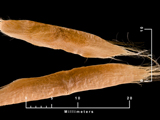
Fruit: Capsules long and slender, up to 18 inches long, up to 1/2 inch broad, containing many seeds; seeds in pairs, winged, with a tuft of hair at the tip of each wing.
Bloom Information
Bloom Color: WhiteBloom Time: May , Jun
Distribution
USA: AL , AR , AZ , CA , CT , DC , DE , FL , GA , IA , IL , IN , KS , KY , LA , MA , MD , ME , MO , MS , NC , ND , NJ , NY , OH , OK , OR , PA , RI , SC , TN , TX , UT , VA , VT , WVNative Distribution: Gulf Coast from n. FL to e. MS; widely naturalized elsewhere
Native Habitat: Stream banks; wetlands; low woodlands
Growing Conditions
Water Use: LowLight Requirement: Part Shade
Soil Moisture: Wet
CaCO3 Tolerance: Medium
Soil Description: Wet to moist soils.
Conditions Comments: Some landowners and designers consider this nearly indestructible tree a nuisance because the leaves smell bad when crushed, flowers litter the ground with decaying petals after a too-brief appearance, and root suckers can create a problem. A particular green & black striped caterpillar can completely defoliate southern catalpa trees, but the trees recover, growing new set of leaves withing a month.
Benefit
Use Ornamental: The tree is cultivated as an ornamental but has long since escaped cultivation.Conspicuous Flowers: yes
Interesting Foliage: yes
Value to Beneficial Insects
Special Value to Honey BeesThis information was provided by the Pollinator Program at The Xerces Society for Invertebrate Conservation.
Propagation
Description: Seeds require no stratification or scarification. Both hardwood and softwood stem cuttings can be used for propagation.Seed Collection: Capsules split and disperse seed in late winter or early spring. Collect fruits after capsules brown and begin to dry. Insect infestation is likely if left on the tree too long. Dry, cold storage is recommended.
Commercially Avail: yes
National Wetland Indicator Status
| Region: | AGCP | AK | AW | CB | EMP | GP | HI | MW | NCNE | WMVE |
| Status: | UPL | UPL | FACU | UPL | FACU | FACU | UPL |
From the National Organizations Directory
According to the species list provided by Affiliate Organizations, this plant is on display at the following locations:Nueces River Authority - Uvalde, TX
Bibliography
Bibref 841 - Native Alternatives to Invasive Plants (2006) Burrell, C. C.Bibref 248 - Texas Wildflowers: A Field Guide (1984) Loughmiller, C. & L. Loughmiller
Search More Titles in Bibliography
Web Reference
Webref 17 - Southern Wetland Flora: Field Office Guide to Plant Species (0) U.S. Department of Agriculture. No date. Southern wetland flora: Field office guide to plant species. U.S.D.A. Soil Conservation Service, South Nat...Additional resources
USDA: Find Catalpa bignonioides in USDA PlantsFNA: Find Catalpa bignonioides in the Flora of North America (if available)
Google: Search Google for Catalpa bignonioides
Metadata
Record Modified: 2017-12-12Research By: TWC Staff