Native Plants

Plant Database
Search for native plants by scientific name, common name or family. If you are not sure what you are looking for, try the Combination Search or our Recommended Species lists.
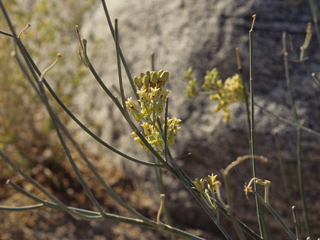
Wasowski, Sally and Andy
Asclepias subulata
Asclepias subulata Decne.
Rush Milkweed, Desert Milkweed, Ajamete
Asclepiadaceae (Milkweed Family)
Synonym(s):
USDA Symbol: ASSU
USDA Native Status: L48 (N)
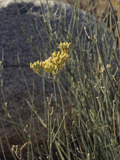
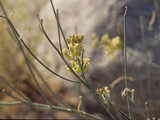
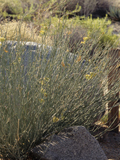
Mature plants of this species are striking in appearance with many leafless stems rising from a single root crown with a density similar to that of horsetails. Like many desert perennials, this shrubby, leafless milkweed bears leaves only after rain. The long greenish-white stems occur in clusters. Whitish-green flowers bloom in terminal clusters and are followed by narrow, milkweed pods.
One of the few evergreen milkweeds native to the U.S.


Plant Characteristics
Duration: PerennialHabit: Herb
Root Type: Tap
Leaf Retention: Evergreen
Leaf Arrangement: Opposite
Leaf Shape: Linear
Fruit Type: Follicle
Size Notes: Up to about 9 feet tall with a 4 feet spread.
Leaf: Leaves are indistinct (small) and tend to be maintained only when moisture is adequate. Photosynthesis appears to be accomplished via greenish-white tissues that cover numerous erect stems. Leaf arrangement is opposite. Grows as numerous stems off a common root crown. Color is a grayish green. Remains leafless until after rainfalls. Leave shape is linear, 1-2 in (2 1/2-5 cm) long by up to 1/8 in (3 cm) wide.
Flower: Umbels stand erect with 10 +/- flowers per umbel located at top part of stem. Flower is glabrous, approximately 1/2 inch (1.5 cm) long by 1/4 inch (.5 cm) wide. Corolla, hoods, and horns are cream, white, or yellow color. Corolla folds back to expose hoods and horns.
Fruit: Pods narrow, smooth, glabrous, downwardly directed and 2-4 in (5-10 cm) long when mature.
Bloom Information
Bloom Color: White , YellowBloom Time: Apr , May , Jun , Jul , Aug , Sep , Oct , Nov , Dec
Distribution
USA: AZ , CA , NVNative Distribution: S. AZ, s.e. CA & n.w. Mex.
Native Habitat: Dry slopes, mesas, plains & desert washes to 3000 ft.
Growing Conditions
Water Use: LowLight Requirement: Sun
Soil Moisture: Dry
Soil Description: Dry, rocky or sandy soils.
Conditions Comments: Shade tolerant under desert conditions.
Benefit
Use Wildlife: Forage source for the Monarch and Striated Queen Butterflies.Warning: All plants in the genus Asclepias are probably somewhat toxic, some fatally so, to both humans and animals. The sap of some causes skin irritation in humans. Sensitivity to a toxin varies with a person’s age, weight, physical condition, and individual susceptibility. Children are most vulnerable because of their curiosity and small size. Toxicity can vary in a plant according to season, the plant’s different parts, and its stage of growth; and plants can absorb toxic substances, such as herbicides, pesticides, and pollutants from the water, air, and soil.
Attracts: Butterflies
Value to Beneficial Insects
Special Value to Native BeesSpecial Value to Bumble Bees
Special Value to Honey Bees
Supports Conservation Biological Control
This information was provided by the Pollinator Program at The Xerces Society for Invertebrate Conservation.
Bibliography
Bibref 995 - Native Landscaping from El Paso to L.A. (2000) Wasowski, S. and A. WasowskiSearch More Titles in Bibliography
Additional resources
USDA: Find Asclepias subulata in USDA PlantsFNA: Find Asclepias subulata in the Flora of North America (if available)
Google: Search Google for Asclepias subulata
Metadata
Record Modified: 2022-09-18Research By: TWC Staff