Native Plants

Plant Database
Search for native plants by scientific name, common name or family. If you are not sure what you are looking for, try the Combination Search or our Recommended Species lists.
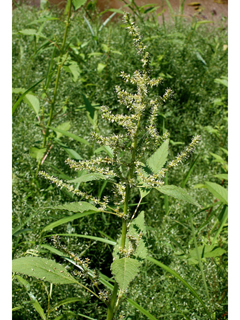
Smith, R.W.
Amaranthus tuberculatus
Amaranthus tuberculatus (Moq.) Sauer
Roughfruit Amaranth, Water Hemp
Amaranthaceae (Amaranth Family)
Synonym(s): Acnida altissima, Acnida altissima var. prostrata, Acnida altissima var. subnuda, Acnida concatenata, Acnida subnuda, Acnida tamariscina, Acnida tamariscina var. prostrata, Acnida tuberculata, Amaranthus altissimus, Amaranthus ambigens, Amaranthus rudis, Amaranthus tamariscinus, Amaranthus tuberculatus var. prostratus, Amaranthus tuberculatus var. subnudus
USDA Symbol: AMTU
USDA Native Status: L48 (N), CAN (N)
The Amaranthaceae are a family of annual or perennial herbs with small, crowded flowers. There are usually 5 sepals and no petals. Filaments of the stamens are often united into a short tube.
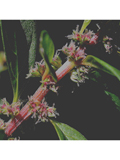
Plant Characteristics
Duration: AnnualHabit: Herb
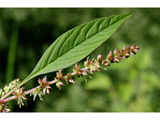
Leaf Arrangement: Alternate
Leaf Complexity: Simple
Leaf Shape: Elliptic , Oblong , Obovate , Ovate
Leaf Margin: Entire
Leaf Apex: Acute , Obtuse
Leaf Base: Cuneate
Breeding System: Dioecious
Inflorescence: Panicle , Spike , Terminal
Size Notes: Up to about 6 feet tall, occasionally taller.
Fruit: Utricle.
Bloom Information
Bloom Color: White , Pink , GreenBloom Time: Jun , Jul , Aug , Sep , Oct , Nov
Distribution
USA: AL , AR , CT , GA , IA , IL , IN , KY , LA , MA , ME , MI , MN , MO , MS , NC , ND , NE , NH , NY , OH , PA , SD , TN , VT , WI , WVCanada: PE
Growing Conditions
Soil Moisture: MoistBenefit
Attracts: ButterfliesLarval Host: Common Checkered-skipper
Butterflies and Moths of North America (BAMONA)
|
Common Checkered-Skipper (Pyrgus communis) 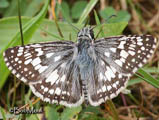 Larval Host |
National Wetland Indicator Status
| Region: | AGCP | AK | AW | CB | EMP | GP | HI | MW | NCNE | WMVE |
| Status: | FACW | FACW | FACW | FAC | OBL | OBL | OBL |
Bibliography
Bibref 1186 - Field Guide to Moths of Eastern North America (2005) Covell, C.V., Jr.Bibref 1185 - Field Guide to Western Butterflies (Peterson Field Guides) (1999) Opler, P.A. and A.B. Wright
Search More Titles in Bibliography
Web Reference
Webref 30 - Calflora (2018) CalfloraWebref 38 - Flora of North America (2019) Missouri Botanical Garden, St. Louis, MO & Harvard University Herbaria, Cambridge, MA.
Webref 23 - Southwest Environmental Information Network (2009) SEINet - Arizona Chapter
Additional resources
USDA: Find Amaranthus tuberculatus in USDA PlantsFNA: Find Amaranthus tuberculatus in the Flora of North America (if available)
Google: Search Google for Amaranthus tuberculatus
Metadata
Record Modified: 2022-11-11Research By: TWC Staff