Native Plants

Plant Database
Search for native plants by scientific name, common name or family. If you are not sure what you are looking for, try the Combination Search or our Recommended Species lists.
Bransford, W.D. and Dolphia
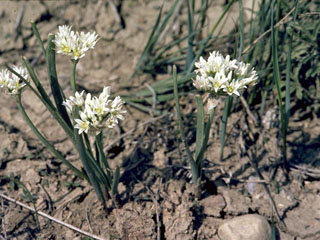
Allium textile
Allium textile A. Nelson & J.F. Macbr.
Textile Onion
Liliaceae (Lily Family)
Synonym(s): Allium aridum, Allium geyeri var. textile, Allium reticulatum, Allium reticulatum var. playanum
USDA Symbol: ALTE
USDA Native Status: L48 (N), CAN (N)
Plant Characteristics
Duration: PerennialHabit: Herb
Leaf Complexity: Simple
Leaf Margin: Denticulate , Entire
Leaf Apex: Acuminate
Fruit Type: Capsule
Size Notes: Scape up to about 16 inches tall.
Leaf: Green
Fruit: Seeds black.
Bloom Information
Bloom Color: WhiteBloom Time: Apr , May , Jun
Distribution
USA: CO , IA , ID , KS , MN , MT , ND , NE , NM , NV , SD , UT , WA , WYCanada: SK
Native Habitat: Prairie/Meadow/Field
Growing Conditions
Water Use: MediumLight Requirement: Sun
Soil Moisture: Dry
CaCO3 Tolerance: Medium
Benefit
Use Wildlife: Hummingbirds, ButterfliesUse Food: EDIBLE PARTS: Leaves, bulbs and bulblets. Field garlic (A. vineale) is too strong for most tastes. Gather leaves during spring and fall. Gather bulbs in the second year when they are large enough to use like cultivated onions. Flower stem bulblets are collected during the summer. Use as domestic onions, for seasoning or raw in salads. Bulbs can be used raw, boiled, pickled or for seasoning. Their strong taste can be reduced by parboiling and discarding the water. To freeze onions or garlic, one should coarsely chop, blanch two minutes, drain, pat dry and place them into plastic bags. The bulbs can also be dried for use as seasoning. Use flower bulbs to flavor soup or for pickling. (Poisonous Plants of N.C.)
Warning: POISONOUS PARTS: All parts but causes only low toxicity if eaten; can be safely eaten in small amounts, large quantities not recommended. Symptoms may include nausea, vomiting, diarrhea. Toxic Principle: Sulfides. (Poisonous Plants of N.C.)
Conspicuous Flowers: yes
Attracts: Hummingbirds
Web Reference
Webref 62 - Burke Herbarium Image Collection (2020) University of WashingtonWebref 38 - Flora of North America (2019) Missouri Botanical Garden, St. Louis, MO & Harvard University Herbaria, Cambridge, MA.
Webref 23 - Southwest Environmental Information Network (2009) SEINet - Arizona Chapter
Additional resources
USDA: Find Allium textile in USDA PlantsFNA: Find Allium textile in the Flora of North America (if available)
Google: Search Google for Allium textile
Metadata
Record Modified: 2023-04-10Research By: TWC Staff