Native Plants

Plant Database
Search for native plants by scientific name, common name or family. If you are not sure what you are looking for, try the Combination Search or our Recommended Species lists.
Beckers, Eric
Abies lasiocarpa
Abies lasiocarpa (Hook.) Nutt.
Subalpine Fir
Pinaceae (Pine Family)
Synonym(s):
USDA Symbol: ABLA
USDA Native Status: L48 (N), AK (N), CAN (N)
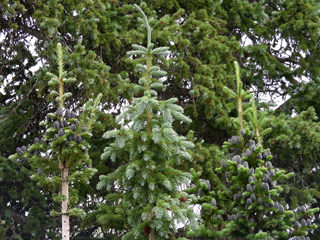
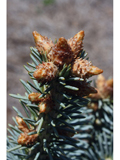
At maturity this is a small, 30-50 ft., spire-like evergreen with stiff, horizontal limbs branched to the ground. Pale, bluish-green needles and grayish or chalk-white bark are distinguishing characteristics. Its smooth, upright cones are brilliant purple until maturity. The most widespread western true fir, with dense, long-pointed, spirelike crown and rows of horizontal branches reaching nearly to base; shrubby at timberline.
The spires of Subalpine Fir add beauty to the Rocky Mountain peaks. When weighted down to the ground with snow, the lowest branches sometimes take root, forming new shoots. The bark of this and related firs is browsed by deer, elk, bighorn sheep, and moose; the leaves are eaten by grouse, and the seeds are consumed by songbirds and mammals. The scientific name, meaning "hairy-fruited," refers to the cones. Corkbark Fir (var. arizonica (Merriam) Lemm.), a variety from Arizona to Colorado, has thin, whitish, corky bark. Some authorities consider the variety lasiocarpa ((Hook.) Nutt.) as a separate species, A. bifolia.
Plant Characteristics
Duration: PerennialHabit: Tree
Leaf Retention: Evergreen
Leaf Complexity: Simple
Leaf Shape: Linear
Breeding System: Flowers Unisexual , Monoecious
Fruit Type: Cone
Size Notes: Up to about 50 feet tall.
Leaf: Green
Bloom Information
Bloom Color: White , GreenBloom Time: Apr , May
Distribution
USA: AK , AZ , CA , CO , ID , MT , NM , NV , OR , UT , WA , WYCanada: AB , BC , YT
Native Distribution: Yukon & s. AK, s. to NM & AZ
Native Habitat: Mts. above 8000 ft.
Growing Conditions
Water Use: MediumLight Requirement: Sun , Part Shade , Shade
Soil Moisture: Moist
Soil pH: Acidic (pH<6.8)
CaCO3 Tolerance: Low
Soil Description: Moist to dry, gravelly or sandy loams.
Conditions Comments: Subalpine fir is disease and insect resistant. It fir has been extensively collected in the wild at great detriment to the species and its native habitat. Verify that commercially available plants are nursery grown. Aibes lasiocarpa var. arizonica is considered more ornamental but less hardy than the species.
Benefit
Use Wildlife: Provides valuable cover for birds and small mammals.Fragrant Foliage: yes
Attracts: Birds
Propagation
Description: This species should be sown from seed. It is a slow process. In nature, Abies seeds often germinate on melting snow fields.Seed Collection: Optimum seed bearing age is 150-200 years. A good seed crop is produced every second year. Cones can be harvested in avalanche areas or from squirrel caches. Cone scales bear two seeds at the base. Mature seed has a large wing and is ovoid to oblong. Seeds can be damaged easily. Seeds store best in a dry, cool environment.
Seed Treatment: Stratification for 3 months at 30 degrees improves germination.
Commercially Avail: yes
Find Seed or Plants
Find seed sources for this species at the Native Seed Network.
View propagation protocol from Native Plants Network.
National Wetland Indicator Status
| Region: | AGCP | AK | AW | CB | EMP | GP | HI | MW | NCNE | WMVE |
| Status: | UPL | FACU | FACU |
From the National Organizations Directory
According to the species list provided by Affiliate Organizations, this plant is on display at the following locations:Native Seed Network - Corvallis, OR
Additional resources
USDA: Find Abies lasiocarpa in USDA PlantsFNA: Find Abies lasiocarpa in the Flora of North America (if available)
Google: Search Google for Abies lasiocarpa
Metadata
Record Modified: 2015-05-06Research By: TWC Staff