Native Plants

Q. Who is Mr. Smarty Plants?
A: There are those who suspect Wildflower Center volunteers are the culpable and capable culprits. Yet, others think staff members play some, albeit small, role. You can torture us with your plant questions, but we will never reveal the Green Guru's secret identity.
Did you know you can access the Native Plant Information Network with your web-enabled smartphone?

Ask Mr. Smarty Plants
Ask Mr. Smarty Plants is a free service provided by the staff and volunteers at the Lady Bird Johnson Wildflower Center.

rate this answer

Friday - November 23, 2012
From: San Antonio, TX
Region: Southwest
Topic: Plant Identification, Vines
Title: Identity of milkweed vine with smooth seedpod
Answered by: Nan Hampton
QUESTION:
I believe the vine I am curious about may be Matelea reticulata. However, most of the pictures I have seen of that vine show bumps on the exterior of the seed pod, and the pod I have is green and smooth. I have never seen the vine in bloom. I would attach a picture, but I can't seem to find that option on this page. Thanks.ANSWER:
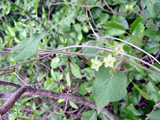
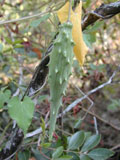
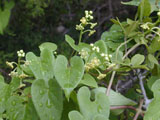
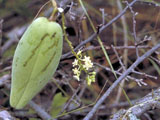
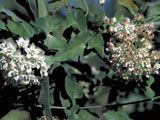
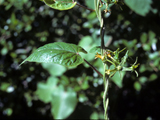
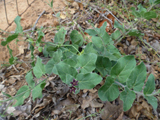
There are several milkweed vines (Family Asclepiadaceae) that have leaves that look similar to those of Matelea reticulata (Green milkweed vine). Here is the USDA Plants Database County Distribution Map for Texas for Matelea reticulata. The pods, holding the seeds, are called follicles.
Cynanchum racemosum var. unifarium (Talayote) has similar leaves and smooth green follicles. The USDA Plants Database County Distribution Map for Texas shows it occurring in Blanco County adjacent to Bexar County.
Photos of the follicles of Funastrum cynanchoides ssp. cynanchoides (Fringed twinevine) are difficult to find, but Southeastern Arizona Wildflowers has photos of Funastrum cynanchoides (without the subspecies indicator), including photos of the follicles. The USDA Plants Database County Distribution Map for Texas shows it in Comal County adjacent to Bexar County. Shinners & Mahler's Illustrated Flora of North Central Texas on p. 283 says that the follicles of Funastrum are smooth. There is a line drawing on p. 285.
Matelea gonocarpos (Anglepod) has a follicle without bumps on the exterior but does have ridges—thus the common name of Anglepod. Here are photos from Vanderbilt University showing the pod. The USDA Plants Database County Distribution Map for Texas shows it occurring in Kendall and Comal Counties adjacent to Bexar.
Matelea cynanchoides (Prairie milkvine) has leaves that look a bit like those of Matelea reticulata and does occur in Bexar County according to the USDA Plants Database County Distribution Map for Texas. The photos shown on the Louisiana Department of Wildlife and Fisheries webpage shows what appears to be smooth follicle. However, the description in Correll & Johnston Manual of the Vascular Plants of Texas (p.1238) describes the follicle as being "more or less muricate" (muricate = "covered with short hard protuberances" according to the University of North Carolina Plant Information Center's Botanical Dictionary).
Cynanchum laeve (honeyvine) has a similar leaves and a smooth follicle; but the nearest reported occurrence to Bexar County on the USDA Plants Database County Distribution Map for Texas is in Travis, Bastrop and Gonzales Counties.
There may be enough in the photos and information above to determine which milkweed vine you have found. If not you might be able to separate your plant from the other species by comparing other features such as leaf arrangement of the presence of hairs on the leaves and stems. In Shinners & Mahler's Flora of North Central Texas, from pages 281 through 286, there are descriptions and line drawings of all of the above species. You might also save the follicle and its seeds and try growing them next year to see its flowers. Visit MonarchWatch.com for information about propagating milkweed seeds.
We no longer accept photographs of plants for identification because we did not have enough staff or volunteers to handle the volume of photos we received. We do, however, show links on our Plant Identification page to several plant identification forums that will accept photos for identification.
From the Image Gallery
More Plant Identification Questions
Plant Identification
October 31, 2013 - I have a plant that is about 6ft high, single stem or 2 or 3 together. from this stem are leaves, alternate and large, about 5-6 inches long, they are about 2.5" wide, irregular edges from the middle...
view the full question and answer
Identificaation of volunteer plant in Maine
July 31, 2007 - I have a volunteer in my garden in Maine that I have been unable to identify. It is a perennial that grows in full sun. It has formed a thick mat of plants whose leaves are about and its leaves are d...
view the full question and answer
Mystery small tree with many large thorns
May 09, 2011 - In a small spot on over 2 acres, we have this strange tree/shrub. It is a single, straight stem with no branches, and has profuse, large thorns from top to bottom. At the top of the stem, the leaves...
view the full question and answer
Possible cinnamon-scented plants in Mississippi delta
July 11, 2005 - I used to live in Mississippi and now live in Illinois. I am trying to find what plant or tree has a strong cinnamon-like scent that fills the air. I noticed this scent driving through the delta in Mi...
view the full question and answer
Need to identify a strange plant in my flowerbed
March 05, 2010 - I have a strange plant that I've called a weed in my flowerbed. It doesn't have many leaves but it has round white almost bulbs at the surface of the dirt. The "bulbs" look almost like a small oni...
view the full question and answer
| Support the Wildflower Center by Donating Online or Becoming a Member today. |