Native Plants

Q. Who is Mr. Smarty Plants?
A: There are those who suspect Wildflower Center volunteers are the culpable and capable culprits. Yet, others think staff members play some, albeit small, role. You can torture us with your plant questions, but we will never reveal the Green Guru's secret identity.

Did you know you can access the Native Plant Information Network with your web-enabled smartphone?

Ask Mr. Smarty Plants
Ask Mr. Smarty Plants is a free service provided by the staff and volunteers at the Lady Bird Johnson Wildflower Center.

rate this answer

Friday - October 19, 2012
From: Austin, TX
Region: Southwest
Topic: General Botany, Cacti and Succulents
Title: Information about prickly pear cactus for school project
Answered by: Nan Hampton
QUESTION:
Hello my name is Case Danzeiser. I go to a middle school called Clint Small Middle School in Austin, Texas. We are doing a species study on a native Texas plants and animals. I choose to study the prickly pear cactus. I am contacting you because I want to be an expert on the plant that I choose. I was hoping that you could give me information about my species. I was also hoping that you could describe the work that you do. If there is anything I can do to help you with your research please let me know.ANSWER:
First of all, you can learn about the work the Wildflower Center does by visiting our webpage. Look especially at the entries under "ABOUT", "CONSERVATION" and "EDUCATION". If you see an activity that interests you in particular, you can go to our CONTACT US page and send an e-mail asking us if you could volunteer to help in that area. You can also visit the VOLUNTEER page to see what opportunities are available there as well.
It is easy to do your own research for your report on our webpage. First, visit our Native Plant Database and enter "prickly pear" into the Name slot under Search native plant database: and then click Go. This will lead you to a page listing 11 different species called "prickly pear". Not all of those are the common ones we know in Travis County as "prickly pear cactus". Indeed, many of them don't occur in Travis County at all, but the ones that we commonly think of as prickly pear cactus here are Opuntia engelmannii var. lindheimeri (Texas pricklypear) and Opuntia macrorhiza (Common prickly-pear). They are closely related and not easy to tell apart. I suppose you could do your report on one or both of them. You can decide, but it would be simplest to use the first one, Opuntia engelmannii var. lindheimeri, since there is more information on our webpage. Visit the species page that has a lot of information about the plant, such as the plant's characteristics, its distribution and growing conditions and much more. If you scroll down to the bottom of the page on the species page, you will find a heading called ADDITIONAL RESOURCES. If you click on the link for the USDA, you will go to the page for Texas prickly pear in the USDA Plants Database to see what information they have. If you click on the link for FNA (Flora of North America), you will find information about the species in FNA online. If you click on the Google link, you will find many articles about Texas prickly pear from other webpages such as the Archive of Central Texas Plants from the School of Biological Sciences at the University of Texas. Good luck with your report!
From the Image Gallery
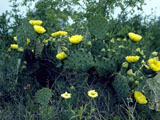
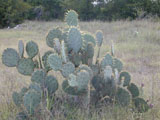
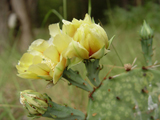
More Cacti and Succulents Questions
Use of Century Plant bloom as indoor decoration
December 09, 2008 - Mr. Smarty Pants,
After living in Arizona and now San Antonio, I am in search of a Century Plant Bloom. I cannot have an evergreen because my cats climb them. I would shellac the stalk and blooms a...
view the full question and answer
Propagation of Agave suckers
November 18, 2014 - I'm trying to transplant Dragon Toes Agave suckers. Is this similar to other agave pup transplants?
view the full question and answer
Wholesale dry yucca trunks and branches from California
January 29, 2012 - Where can I buy wholesale dry yucca trunks and branches? I have spent the last hour looking for them and can only find nurseries and decorative branches.
view the full question and answer
Will the blooming stalk of my century plant eventually tip over? Yes
June 24, 2009 - I have a century plant in bloom. Will the stalk eventually tip over? Would appreciate any Internet references on the subject.
view the full question and answer
How to Control White Fungus on Prickly Pear Cactus?
July 04, 2013 - Is there any kind of spray for our prickly pear that will help with the white fungus that has appeared on it?
view the full question and answer
| Support the Wildflower Center by Donating Online or Becoming a Member today. |