Native Plants

Q. Who is Mr. Smarty Plants?
A: There are those who suspect Wildflower Center volunteers are the culpable and capable culprits. Yet, others think staff members play some, albeit small, role. You can torture us with your plant questions, but we will never reveal the Green Guru's secret identity.

Did you know you can access the Native Plant Information Network with your web-enabled smartphone?

Ask Mr. Smarty Plants
Ask Mr. Smarty Plants is a free service provided by the staff and volunteers at the Lady Bird Johnson Wildflower Center.

rate this answer

Monday - September 17, 2012
From: Justin, TX
Region: Southwest
Topic: Diseases and Disorders, Trees
Title: Problems with mature cottonwood in Justin TX
Answered by: Barbara Medford
QUESTION:
I have a very large, 90" circumference, approx 60' tall, cottonwood tree in my front yard that appears to be sick. The trunk splits at about the 4' level into 2 parts. at that split is a 10" wide "wet" spot that is sappy & soft. I called an aborist who charged a lot to look for less than a minute & diagnoised it with "slime flux canker." He then wanted another $450. to have someone come out to treat it with alcohol & some spikes drilled into trunk. All the info that I could get off the internet seems to say that the tree cannot be saved, so I am reluctant to pay to have it treated. Can you please advise? I had made several calls to the National Forest service & got referred to a different arborist that never returned my calls. It is my only shade tree in the middle of the front yard, about 30' from the house. That means if it falls over, chances are it will damage my mobile home. Can you advise me as to what measures I should seek now? There were only 2 arborist in this area to call upon. Thank you. Justin, TXANSWER:
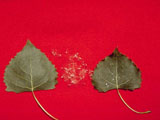
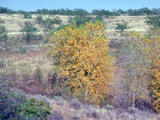
According to this USDA Plant Profile Map, the tree is indeed native to Denton County. We always check this first to make sure a plant belongs where it is growing, because growing out of its native climate and soil can definitely contribute to the problems that plant might be having.
If you follow this link, Populus deltoides (Eastern cottonwood), to our webpage on it, you will see it has high water needs and the size it has reached probably represents its mature size. We have also noted from other sources that it is considered a fast-growing tree, often planted for quick shade and therefore not particularly long-lived.
The most comprehensive article we found on this article is from the USDA Forest Service. Note especially this comment:
"Numerous disease organisms attack cottonwood. Septoria musiva causes a small canker that opens a path for other canker organisms. Cytospora chrysosperma causes a canker where sites are adverse and tree vigor is low. Fusarium solani enters wounds, particularly after major floods, to cause a canker. Two other canker-producing organisms are Phomopsis macrospora and Botryodiplodia theobromae. On vigorous trees, cankers usually callus over. Melampsora medusae causes leaf rust which results in premature defoliation and reduced growth rate. Marssonina brunnea causes a leaf spot that also results in early defoliation. Septoria musiva, in addition to causing a canker, causes a leaf spot. New leaves may be infected from old leaves or cankers."
From the University of Connecticut, here is another list of liabilities for your tree:
 Liabilities
- do not plant near sewers, septic tanks, drains or sidewalks
- suckers
- canker
- short-lived
- too many to name
In summary, we agree with you that the cost of treatment of a slime disease is not worth it. The tree has already probably grown past its healthy maturity, and is, as you noted, a threat to your property. We feel it should come down and that presents yet another list of difficulties. Taking down a tree of that size will not be a do-it-yourself project, there needs to be special equipment and trained personnel to do it without damaging the surrounding area. You mentioned you lived in a mobile home? Do you rent the land for it? If so, the tree should be the responsibility of the landowner. Perhaps you can locate someone who cuts wood for fireplaces that would have the ability to take down the tree, in order to get the wood. Of course, an arborist would be the first choice for that job, but you have already noted there are not many in your area.
About our best advice is to go to our National Suppliers Directory and type in your town and state or just your zip code in the "Enter Search Location" box. This will give you a list of native plant seed companies, nurseries and consultants, which should include arborists, in your general area. All should have contact information, so you can find out in advance estimated charges and when it could be done.
From the Image Gallery

More Trees Questions
Privacy screening from Prosperity SC
May 19, 2013 - I need to know what would be a good tree to plant for blocking my neighbor's home it needs to be an evergreen and slender in the space it would take.
view the full question and answer
Replacement evergreens under power line in Wisconsin
April 11, 2013 - I have to replace evergreen trees in a privacy screen due to borer damage. The screen is below power lines so the replacements cannot be tall. I would like use bird and pollinator friendly replaceme...
view the full question and answer
Southern Live Oak Authority for Jackson MS
June 23, 2016 - Who are the foremost authorities on Southern Live Oaks? May need expert testimony to oppose cutting of 50 year-old live oaks in boulevard of Riverside Drive in Jackson, MS
view the full question and answer
Smarty Plants on Diospyros virginiana
July 29, 2005 - Diospyros virginiana (common persimmon) is, from what I understand, a host
plant for the stunning Luna Moth caterpillar which supposedly can occur this
far west. Your database entry for Diospyros do...
view the full question and answer
California plants poisonous to dogs from Sacramento
July 01, 2012 - Found dodonea viscosa purple. Is it poisonous to dogs? Also Gold Star Potentilla.
Going drought tolerant and need small trees, shrubs and plants not poisonous to dogs for sun and partial sun.
view the full question and answer
| Support the Wildflower Center by Donating Online or Becoming a Member today. |