Native Plants

Q. Who is Mr. Smarty Plants?
A: There are those who suspect Wildflower Center volunteers are the culpable and capable culprits. Yet, others think staff members play some, albeit small, role. You can torture us with your plant questions, but we will never reveal the Green Guru's secret identity.

Did you know you can access the Native Plant Information Network with your web-enabled smartphone?

Ask Mr. Smarty Plants
Ask Mr. Smarty Plants is a free service provided by the staff and volunteers at the Lady Bird Johnson Wildflower Center.

rate this answer

Tuesday - July 03, 2012
From: San Antonio, TX
Region: Southwest
Topic: Non-Natives, Planting, Shrubs
Title: Replacing yellow bells with hibiscus from San Antonio
Answered by: Barbara Medford
QUESTION:
Help! Will the roots of the yellow bells keep sprouting if I've removed the shrub? I'm replacing it with a hibiscus shrub. Will it do well in the same spot where the yellow bells were?ANSWER:
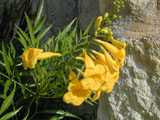
Our research didn't turn up a single mention of adventitious sprouts on Tecoma stans (Yellow bells). In fact, it is frequently used as a container plant, which indicates to us there is not a root problem. You obviously know about sprouts on other plants, many kinds of trees, including oaks, which can be unsightly and even cause invasiveness. In this case, you said you dug out the roots, so we think the roots are gone.
As to your question on whether a hibiscus would do as well in the same spot. We have a question for you. Why did you take out an obviously climate friendly native plant that is showy and low water use, to replace it with an hibiscus?
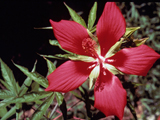
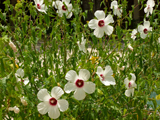
There are 9 species of the family Malvavaceae (mallow), genus Hibiscus, with the word "hibiscus" in their common names that are native to Texas. Most of these natives did indicate they would survive in the same conditions as the yellow bells, but several indicated a need for acidic soils (in Central Texas, most soils are alkaline) and high water use. However, we are betting you purchased a (probably) non-native tropical hibiscus, for their showy flowers. Here is an article from Clemson Coopertive Extension on Hibiscus.
Bottom line: We don't really have a definitive answer to your question about sprouts, and we think your hibiscus will probably do all right, particularly if you prepared the hole properly and keep it well watered. It would not be our personal choice, as the Lady Bird Johnson Wildflower Center is dedicated to the growth, propagation and protection of plants native not only to North America but to the area in which they grow naturally. The reason for this is conservation of resources, including purchase price, water and labor.
From the Image Gallery
More Non-Natives Questions
Moving non-native globe willow in Ft. Worth TX
August 10, 2009 - I planted a globe willow in a small area in front of my house and it is probably going to need more space. Can I replant it in a more open area without killing it? It is about 8-9 ft tall, 2-3 ft of ...
view the full question and answer
Identification of red/yellow/black flower in California
April 15, 2013 - Plant found, April Mount Diablo CA 6 symmetrical petals red with a pattern of a yellow flower with black edge in the centre, I can not identify, please help.
view the full question and answer
White specks on unknown houseplant from Ridgeway SC
June 20, 2013 - I have an unknown houseplant that seems to have some sort of pest or disease on it. It has white snowy specks atop its leaf. I bought this purple fuzzy leafed houseplant from Walmart in Winnsboro, SC ...
view the full question and answer
Removal of non-native zoysia grass from Burgettstown PA
September 12, 2013 - What is the most effective method of killing zoysia grass? We bought a house that sits in the center of four acres of mature zoysia. It looks beautiful, however, despite our best efforts at "weeding...
view the full question and answer
Problems with non-native Indian hawthorn
April 18, 2009 - We have some Indian Hawthorns that were planted for us by a landscape company. The first year we got a little bit of bloom. Since then the shrubs don't bloom at all. They are in a flower bed up aga...
view the full question and answer
| Support the Wildflower Center by Donating Online or Becoming a Member today. |