Native Plants

Q. Who is Mr. Smarty Plants?
A: There are those who suspect Wildflower Center volunteers are the culpable and capable culprits. Yet, others think staff members play some, albeit small, role. You can torture us with your plant questions, but we will never reveal the Green Guru's secret identity.

Did you know you can access the Native Plant Information Network with your web-enabled smartphone?

Ask Mr. Smarty Plants
Ask Mr. Smarty Plants is a free service provided by the staff and volunteers at the Lady Bird Johnson Wildflower Center.

rate this answer

Friday - June 29, 2012
From: Asheville, NC
Region: Southeast
Topic: Erosion Control, Groundcovers, Grasses or Grass-like, Herbs/Forbs
Title: Ground cover that won't hide snakes from Asheville NC
Answered by: Barbara Medford
QUESTION:
I have an unusual situation: several bare areas in an otherwise wooded area, which receive partial sun, and are not near water -- it rains here frequently, but the soil can become quite dry at times. Drainage is excellent, the soil is mostly a mixture of clay and black topsoil, with varying amounts of sand. The ground is flat to gently sloped. I need something to fill two purposes: erosion control, and provide soft ground cover which will not be unpleasant to walk on barefoot. I'd also like to avoid anything tussocky or high enough to provide refuge for snakes; we have occasional copperheads in this area. Due to topology and other restraints, mowing isn't really an option, so something which stays low and is non-invasive is a must.ANSWER:
Okay, here's the thing: We were mentally choosing selections of plants to present to you for your woodland situation when you hit the part about somewhere you could walk barefoot and the snakes would be visible. Sometimes in the questions we receive, there are just one or two specifications that we can't meet. Frankly, we don't recommend walking barefoot anywhere, even in a manicured garden. There are hornets that live in holes in the ground, ants that will smarm up your leg and who-knows-what? in terms of broken, sharp sticks or rocks.
And the snake situation is this-anyone moving through a known snake area should have on sturdy outdoor shoes, not thongs and not barefoot. We agree a low groundcover would be better but snakes can slither in that as well as deep vegetation, and even hang out in trees and shrubs, where the shoe is not an issue. So, our first recommendations are for sharp eyes and safe shoes.
The best thing for erosion control is grasses, and we are not talking about mowing grasses, but taller ornamental grasses native to North Carolina. Grasses have long fibrous roots. In terms of snake control, we would recommend only the clumping grasses that would not be particularly hospitable to slithering.
We will search our database for grasses and other plants native to North Carolina that fall into a "groundcover" category by specifying 0 to 1' in height. We will also specify partial shade (2 to 6 hours of sun a day) and dry soil. How much this will yield in possibilities, we don't know. You can use the same method by using the Combination Search on our Native Plant Database, putting in your own specifications. We will give you some examples from our search; follow each plant link to our webpage on that plant to learn the growing conditions, propagation methods and water needs.
Groundcover plants for North Carolina:
Adiantum capillus-veneris (Southern maidenhair fern)
Chrysogonum virginianum (Green and gold)
Claytonia caroliniana (Carolina springbeauty)
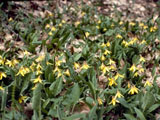
Erythronium americanum (Yellow trout-lily)
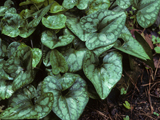
Hexastylis arifolia (Littlebrownjug)
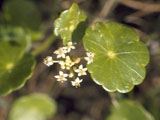
Hydrocotyle umbellata (Manyflower marshpennywort)
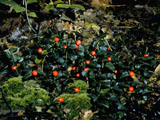
Mitchella repens (Partridgeberry)
Oenothera laciniata (Cutleaf evening-primrose)
Phlox divaricata (Wild blue phlox)
From the Image Gallery
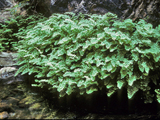
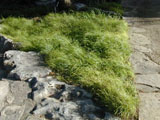
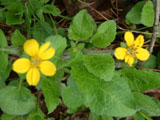
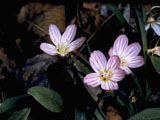
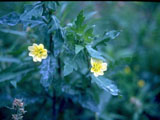
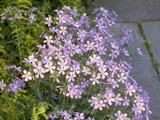
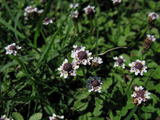
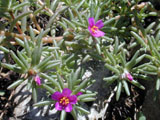
More Grasses or Grass-like Questions
How to eliminate Sawgrass from a small lake in Lindale, TX?
February 23, 2015 - We live on a small acre lake (about 65 acres) and the majority of the lake is surrounded by what the locals are calling saw grass. From the description on the website, I believe they are correct. The...
view the full question and answer
Plants for a Shaded Slope in Philadelphia
April 17, 2015 - I have a small slope along the North side of my house in a suburb of Philadelphia. A small maple tree grows there but most of it gets no sun at all (a large segment is under the tree). I had the soil ...
view the full question and answer
Possible to grow Inland Sea Oats in Oklahoma?
March 17, 2011 - Would it be possible to grow inland sea oats in Southeast Oklahoma? Is this within the range of this plant? I am asking on behalf of my cousin in OK.
view the full question and answer
Non-native smoketree for California City, CA
June 28, 2010 - I was wondering if you could tell me if it would be a good or bad idea to plant a Smoke Tree (most likely European) in the vicinity of a septic tank. We are looking for something which will provide a...
view the full question and answer
Native grasses for Boy Scout project in the Georgetown-Washington DC area
May 29, 2010 - Dear Mr. Smarty Plants,
I am in the process of preparing an extensive native grass planting at Thompson's Boat House in Georgetown, Washington DC for a Boy Scouts of America Eagle Project. It is m...
view the full question and answer
| Support the Wildflower Center by Donating Online or Becoming a Member today. |