Native Plants

Q. Who is Mr. Smarty Plants?
A: There are those who suspect Wildflower Center volunteers are the culpable and capable culprits. Yet, others think staff members play some, albeit small, role. You can torture us with your plant questions, but we will never reveal the Green Guru's secret identity.

Did you know you can access the Native Plant Information Network with your web-enabled smartphone?

Ask Mr. Smarty Plants
Ask Mr. Smarty Plants is a free service provided by the staff and volunteers at the Lady Bird Johnson Wildflower Center.

rate this answer

Sunday - May 20, 2012
From: Seattle, WA
Region: Northwest
Topic: Invasive Plants, Grasses or Grass-like, Herbs/Forbs
Title: Grass for Seattle Arboretum
Answered by: Barbara Medford
QUESTION:
I am writing to you on behalf of the Arboretum at South Seattle Community College Arboretum. I am interested in Panicum virgatum Switch Grass as a plant for a very heavy clay garden in our Arboretum at South Seattle Community College in Seattle Washington. We have in this garden a great deal of native horsetail growing, as well as an assortment of Acers and other cultivars intentionally planted. We are operating this Arboretum of 5 acres as pesticide free and are a 5 Star Enviro-Star garden. We would like to camouflage the horsetail rather than try to eradicate by mechanical means. We have planted a Geranium phaeum Mourning Widow last week to begin the camouflage and I would like to try other plants as well. The intention is to be able to mow once or twice during the growing season to keep things neat. We have a very dedicated intern who is working on this project, Bridget Kelsh and she is documenting and recording her efforts for this project this quarter. My concern is about the level of productivity of the Switch Grass. In your opinion could it be invasive in Western Washington? Just across the path is our Drought Tolerant Perennial Garden, which I fear might become invaded. We are a zone 7a. We enjoy wet cool winters and dry coolish and sometimes warm, summers.ANSWER:
Congratulations on your Arboretum! The Lady Bird Johnson Wildflower Center has, in fact, just had the official Grand Opening, Saturday, May 19, of its own Arboretum. It is trees and plants native to Texas, many of them oaks that have been gathered as acorns over the state and planted. Everyone is extremely excited about it, and we hope you get as much pleasure from your Arboretum as we are from ours.
For clarity on our comments on the plants you are asking about, the Lady Bird Johnson Wildflower Center is dedicated to the growth, propagation and protection of plants native not only to North America, but also to the area in which the plant is being grown. Because of this, we always begin with establishing the area and what is native to it. Our contribution will be to introduce you to our Native Plant Database and make suggestions to select plants for the areas with which you are concerned.
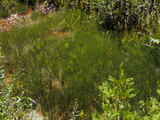
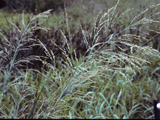
Beginning with Panicum virgatum (Switchgrass), follow the link to our webpage on this plant. You can read about its characteristics, including that it is a rhizomatous clump grass, growing from 3 to 6 feet tall. Go down that webpage to Additional Resources and click on the link to USDA information on the plant. At the bottom of that page is a map of North America, with the states and provinces where Switchgrass grows natively in green. Washington is not green which means it is not native to your state. We always recommend using plants native to an area to reduce the amount of water, fertilizer and care that would be required for a non-native to survive.
Bunch grasses, particularly one that would normally grow to about 6 ft. tall, do not lend themselves to mowing. We have a lot of bunch grasses on the grounds of the Wildflower Center, and they are usually trimmed off with pruning shears near the end of winter. County Extension offices are usually knowledgeable about grasses and we recommend that you contact the Washington State University Extension Office for King County.
In our Native Plant Database, there are 11 members of the Equisetum genus, of which 10 are also native to Washington State. We selected the first one on that list to use as an example, Equisetum arvense (Field horsetail). According to this USDA Plant Profile Map, it does grow natively in Seattle. You are correct that it is basically a wetland plant, and quite capable of being invasive in those kinds of conditions. However, your concern seems to be with its invasiveness in a drought tolerant garden. We are familiar with the fact that you can have very wet, rainy periods which, of course, the horsetail would love. Our opinion (opinion only, no guarantees!) is that if good drainage is maintained in the drought tolerant area that the horsetail would be less likely to invade it. Obviously, you will be attempting to avoid supplemental watering, but if you get the rain, you may have to be vigilant about pulling out the horsetail when it is small and is trying to move into an area where it doesn't belong. Follow the plant link about to our webpage on this plant for its growiing conditions.
Next, we checked our Native Plant Database of Geranium phaeum (Cranesbill) where it did not appear. Further research produced this website from the Universty of Vermont Extension, stating that it is native to moist areas of southern, central and western Europe. We also found one post from Michigan that said it was invasive. From Sunset Plant Finder Dusky Cranesbill.
We suggest, if you find the Switchgrass not appropriate for your space, that you go to our Native Plant Database. Using the Combination Search, select on Washington, then Grass/Grasslike for Habit, and indicate the amount of light the plant will have, the soil moisture, even the mature height the plant should be. Since we don't know what those conditions are, we can't make you a sample list but you will quickly learn to find your way around our database; just remember it will have only plants native to North America.
From the Image Gallery
More Invasive Plants Questions
Invasive horsetail in Etna NH
July 27, 2009 - I seem to have an increasingly "healthy" supply of Equisetum in ALL of my many gardens over the years .. it is not easy to get all the rhizomes (what is?) is it possible to control it some other way...
view the full question and answer
Sources for ruellia from Houston
January 19, 2014 - I want to get a bunch of either ruellia nudiflora or ruellia drummondiana in my butterfly garden. But I cannot find it anywhere, and I have no idea where to get plants or seeds. Seems most vendors...
view the full question and answer
Transplanting Virginia creeper
September 02, 2008 - I have a large Virginia creeper plant approximately 15 feet in length. Is it possible to transplant the whole thing without killing it? If so how do I care for it after it has been moved? Thank yo...
view the full question and answer
Removing invasives plants in Adairsville GA
September 29, 2009 - We just moved into a new house and kudzu, greenbriar and poison ivy are trying to take over. I pulled what I could out of the trees, cut everything off at the base of the vine. I even tried digging ...
view the full question and answer
Native alternatives for invasive species
April 05, 2011 - I'm a native plant landscape designer in central Texas, and know our plants well. Still looking for any help I can get on replacements for Asian jasmine, English ivy, Nandina, and Red tipped photin...
view the full question and answer
| Support the Wildflower Center by Donating Online or Becoming a Member today. |