Native Plants

Q. Who is Mr. Smarty Plants?
A: There are those who suspect Wildflower Center volunteers are the culpable and capable culprits. Yet, others think staff members play some, albeit small, role. You can torture us with your plant questions, but we will never reveal the Green Guru's secret identity.

Did you know you can access the Native Plant Information Network with your web-enabled smartphone?

Ask Mr. Smarty Plants
Ask Mr. Smarty Plants is a free service provided by the staff and volunteers at the Lady Bird Johnson Wildflower Center.

rate this answer

Friday - June 08, 2012
From: Oriole, IN
Region: Midwest
Topic: Rain Gardens, Water Gardens, Erosion Control
Title: Plants for a pond edge in IN
Answered by: Anne Bossart
QUESTION:
Hello, I live in Southern Indiana. I care very much about reinforcing native plants for my region & not planting anything invasive. I had a pond built last year & need some suggestions for native Indiana plants that would grow well along steep banks & also be good for the water & ecosystem. I want to take great care to insure I do not plant any invasives. Can you please offer some suggestion? Much gratitude!ANSWER:
A new pond is the perfect place to plant natives and re-create an ecosystem that will provide widlife habitat and promote biodiversity. You have probably already noticed lots of winged, footed and slithery visitors.
It is easy to find plants native to your area by doing a Combination Search on our Native Plant Database. Simply select Indiana, the plant type you are looking for and the soil and light conditions. The database will generate a list of plants that fit those constraints with links to detailed information pages with images. You can further narrow your search for size, bloom time & color and leaf retention.
When you are choosing plants, you will want plants that tolerate water for the edge, but those that need less for further up the bank. You will also want plants with fibrous root systems like grasses or those that spread by stolons to stablize your steep slope and prevent erosion.
You don't mention whether your pond is in full sun (in the center of your yard) or nestled in part shade. If it is in full sun, you will want to put plants in it like water lilies (or other floating plants) to provide shade and cover for fish and to prevent the growth of algae.
You say you would like to avoid planting invasives. If you restrict your palette to plants that are native to your area and plant them in conditions that are similar to where they occur in nature, you shouldn't have or create a problem. Keep in mind though, that there are some native plants that are, by nature, vigorous spreaders that might seem invasive!
Visit the Landscape for Life website; it is filled with information and instructions you will find helpful. Go to the section about water and read about making a rain garden. Many of the plants that are useful for rain gardens would be good choices for your pond. An internet search for "rain garden" will yield many sites with information and even plant lists. Even if the list is not for your area, there are many plants with very broad native ranges that would be common to yours. For instance this article is published by a group in Canada, yet many of the recommended plants are also native to Indiana. Also this list, published by the Brooklyn Botanic Garden lists plants by area. Simply copy and paste their names into our database for information and images. You can cross reference these lists with one that you generate. A Combination Search for herbaceous plants, sunny and wet conditions lists 75 plant choices.
Here are a few favourites from that list:
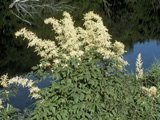
Aruncus dioicus (Bride's feathers)
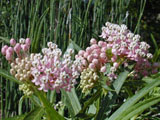
Asclepias incarnata (Swamp milkweed) (this ia a monarch butterfly magnet!)
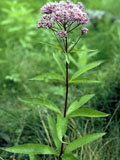
Eupatoriadelphus fistulosus (Trumpetweed) (this one has "found" its way to my pond on it's own)
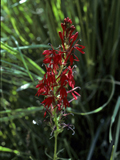
Lobelia cardinalis (Cardinal flower) (hummingbirds love this)
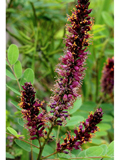
Repeat the exercise searching for shrubs and grasses. You'll find the plants you are looking for to hold your steep bank by carefully reading the description. When you read "This shrub, which often forms thickets on riverbanks and islands, can be weedy or invasive in the northeast." in the description for Amorpha fruticosa (Indigo bush) you know it's a candidate. Remember that the plants further up the bank don't want soil that is wet all the time, just periodically.
From the Image Gallery

More Erosion Control Questions
Preventing Soil Erosion in Elgin, Texas
June 06, 2011 - I live in Elgin,TX and our property is basically a slope with dense oak and cedar trees on the back of the property. The soil is sandy loam. What type of native plants or grasses can I plant to stop...
view the full question and answer
Solution for erosion on steep slope in California
April 14, 2011 - Dear Mr.Smarty Plants,
I have a serious hillside problem in Santa Cruz County resulting from the recent deluge of rain. Steep to sheer now with no plants left on it after the hill slide washed to th...
view the full question and answer
Possibilities of plants for bank shale ledge in Johnstown, PA
April 20, 2008 - We have a mountain that we ripped out to build our house. The remaining ledge is mostly bank shale and everyone is telling us that nothing will grow on the hillside due to it being bank shale and a p...
view the full question and answer
Plants for steep slope in California
November 13, 2010 - Where do I find out about the specific root structure of various California native plants? Are there shrubs that have tap roots & hence are good for steep slopes? The genus of any such plants that y...
view the full question and answer
Full Sun, Wind-Tolerant Shrubs and Vines for Steep MN Hillside
June 26, 2013 - My neighbor and I share a very steep, large (in total almost 200 ft. wide) west-facing hillside in Excelsior, MN on Lake Minnetonka. We both have a flat grass area at the bottom so the hillside does n...
view the full question and answer
| Support the Wildflower Center by Donating Online or Becoming a Member today. |