Native Plants

Q. Who is Mr. Smarty Plants?
A: There are those who suspect Wildflower Center volunteers are the culpable and capable culprits. Yet, others think staff members play some, albeit small, role. You can torture us with your plant questions, but we will never reveal the Green Guru's secret identity.

Did you know you can access the Native Plant Information Network with your web-enabled smartphone?

Ask Mr. Smarty Plants
Ask Mr. Smarty Plants is a free service provided by the staff and volunteers at the Lady Bird Johnson Wildflower Center.

rate this answer

Tuesday - April 10, 2012
From: Colchester, VT
Region: Northeast
Topic: Erosion Control, Grasses or Grass-like
Title: Plants to stabilize a bank in VT
Answered by: Anne Bossart
QUESTION:
I am looking for suggestion on what plants might best be suited for aiding in the stabilization of a very steep bank above Lake Champlain.ANSWER:
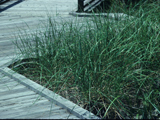
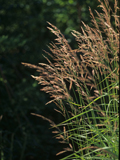
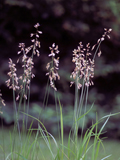
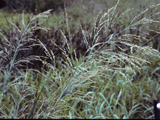
Generally speaking, we recommend planting ornamental grasses to stabilize a steep bank. Their fibrous root systems really hold the soil in place and enable the plant to thrive in the "rapidly draining" (aka dry) soil conditions that are usually present on such a site.
These grasses are native to Vermont and would do the job quite nicely:
Ammophila breviligulata (American beach grass) (this plant can be very aggressive)
Calamagrostis canadensis (Bluejoint)
Hierochloe odorata (Sweetgrass)
Panicum virgatum (Switchgrass)
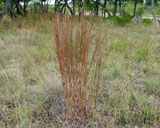
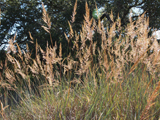
Schizachyrium scoparium (Little bluestem)
Sorghastrum nutans (Indiangrass)
If a mixed planting of grasses, shrubs and flowering perennial plants was more what you had in mind, you will want to select those that spread with runners or stolons.
You can visit our Native Plant database to learn more about which plants might be useful. By doing a Combination Search for Vermont and selecting the plant type (shrub or herb(aceous perennial)) and the light and soil conditions of your site, you will generate lists of plants native to your area that meet those conditions. Each plant name is linked to a detailed information page with images.
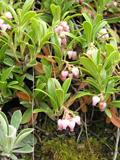
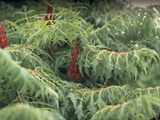
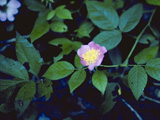
For instance, a search for shrubs using the assumption that your conditions are sunny and dry, generates a list of 39 shrubs. Plants from this list like Arctostaphylos uva-ursi (Kinnikinnick), Rhus typhina (Staghorn sumac) and Rosa carolina (Carolina rose) are all good "spreaders".
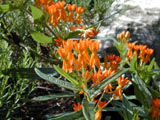
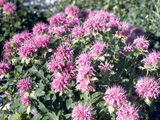
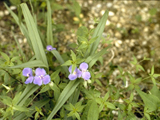
Asclepias tuberosa (Butterflyweed), Monarda fistulosa (Wild bergamot) and Tradescantia virginiana (Virginia spiderwort) are just a few of the perennials from the list of 89 that will also hold the soil. You will find that the perennials that other gardeners are constantly digging up, dividing and sharing will be good "workhorses" for you!
From the Image Gallery
More Grasses or Grass-like Questions
Planting of Habiturf from Smithville TX
March 25, 2012 - Are Habiturf and Thunderturf the same?
and, how late in the year can I plant Habiturf?
view the full question and answer
Native turf grass for Arlington, VA.
September 10, 2015 - Hi, could you please provide me with a recommendation for a native turf grass to plant in a large commercial area in Arlington, Virginia. Currently Kentucky 31 is being used, but we would like to iden...
view the full question and answer
O.K. to grow grass under a live oak?
November 26, 2014 - Is it a bad idea to plant grass around a mature live oak? We have erosion issues and trying to keep mulch in the beds around the tree groves is a challenge, even with edging. Much of the native dirt...
view the full question and answer
Mixture of native grasses as opposed to buffalo grass monoculture
November 26, 2003 - My husband and I just built our home on Lake Travis. Our lot is very rocky and is on the side of a hill. We would like to plant something on the incline at the front of our home that doesn't need a l...
view the full question and answer
Native plants that are dog-proof in South Texas
July 13, 2008 - I live in Odem, Texas and would like to use only native plants in my front and backyard. I have two puppies who love to dig. What plants should I use that require minimal attention from me and will no...
view the full question and answer
| Support the Wildflower Center by Donating Online or Becoming a Member today. |