Native Plants

Q. Who is Mr. Smarty Plants?
A: There are those who suspect Wildflower Center volunteers are the culpable and capable culprits. Yet, others think staff members play some, albeit small, role. You can torture us with your plant questions, but we will never reveal the Green Guru's secret identity.

Did you know you can access the Native Plant Information Network with your web-enabled smartphone?

Ask Mr. Smarty Plants
Ask Mr. Smarty Plants is a free service provided by the staff and volunteers at the Lady Bird Johnson Wildflower Center.

rate this answer

Thursday - February 09, 2012
From: Houston, TX
Region: Southwest
Topic: Planting, Cacti and Succulents
Title: Yucca filamentosa suffering from damp feet in Houston
Answered by: Barbara Medford
QUESTION:
Last year, I planted three enormous and gorgeous Yucca Filamentosa in my backyard. Two are thriving but the third started turning yellow then brown from the bottom up after a few weeks of rains. Since the very top was showing new growth, I thought that maybe I could save this 6 foot wide behemoth. After some research, I decided that it was suffering root rot so I dug it up out of the ground, then I rinsed off all the dirt and started feeling around the root ball until i felt mushy stuff. I cut away a huge portion of the roots in the middle of the root ball. I then trimmed away all the yellow and brown leaves, leaving a rather long bare trunk ( about 15 inches worth) and the still-green crown. Finally, I repotted the remaining plant in fresh soil mixed with some sand. I haven't seen anymore yellowing since. Is there anything more I can do to save this plant?ANSWER:
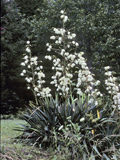
Sounds like the only additional help you could give all 3 of your Yucca filamentosa (Adam's needle) would be to get in your time machine, go back and plant them differently, with good drainage arranged for in advance. No time machine? These plants are tough and with some more attention to keeping the roots from getting so wet, should do just fine.
The real diagnosis here is transplant shock. You took 3 mature plants, the species of which is usually more fitted to deserts, and planted them, when they were already mature, in wet soil. Yuccas are, however, uniquely suited to this kind of mistake, because they propagate with great determination. In fact, once you have a yucca, you HAVE it, if you know what I mean. You can dig a yucca root completely out and throw it away, and in a few months you will have little plantlets coming up in a circle around the location of the original root. They can propagate from seeds, if there are yucca moths in the neighborhood to pollinate them, but they aggressively reproduce from even the smallest scraps of root.
In future, if you wish to plant more, for instance, offshoots of the existing plants, prepare the hole to be more desert-like. You can't do much about the rain (and in Austin we can't seem to do much about the lack of it) but you can make sure that the water that hits the soil around the plant drains away quickly. The use of sand in the new hole was good, adding some decomposed granite would help even more. But starting out with the right kind of hole and amendments is the best plan of all.
Be sure and follow this plant link Yucca filamentosa (Adam's needle) to our webpage on the plant for more information. In addition, here is an excellent article on How to Plant a Yucca Plant. And, finally, from Floridata where it's usually too wet, too, here is an article on Yucca filamentosa.
From the Image Gallery
More Cacti and Succulents Questions
Agave with large stem growing
May 01, 2011 - It is a large stem growing from my agave plant in the middle of it. It looks scary and ugly, what is it? Is it poisonous? Is it rare? It gets taller and taller everyday, what to cut it.
view the full question and answer
Replacement for Spanish Dagger from Georgetown TX
June 22, 2011 - I have a Spanish Dagger plant in my garden which appears to be dying. Where can I purchase a replacement for this plant? The Spanish Dagger I have is close to 10 feet tall.
What is the best way t...
view the full question and answer
Plant ID of succulent from Flagler Beach FL
July 08, 2012 - file:///C:/Users/CircuitCity/Downloads/All%20sizes%20%20%20baby%20plants%20growing%20on%20succulent%20leaves%20%20%20Flickr%20-%20Photo%20Sharing!_files/3901143728_dcf227ea85.jpg
I have a succulent t...
view the full question and answer
Trimming back Agave havardiana
June 05, 2008 - Hi.. thanks for all the great information on Agaves. We have a number of Agave Havardiana (blue) that love where we planted them. Several have gotten HUGE. So much so that they are starting to ge...
view the full question and answer
Growing Native Cactus Indoors in Dallas
December 17, 2015 - I have a Chihuahuan fishhook cactus (Sclerocactus uncinatus), a pincushion cactus (Epithelantha micromeris) and a horse crippler (Echinocactus texensis), which I bring in for the winter, since they te...
view the full question and answer
| Support the Wildflower Center by Donating Online or Becoming a Member today. |