Native Plants
Q. Who is Mr. Smarty Plants?
A: There are those who suspect Wildflower Center volunteers are the culpable and capable culprits. Yet, others think staff members play some, albeit small, role. You can torture us with your plant questions, but we will never reveal the Green Guru's secret identity.
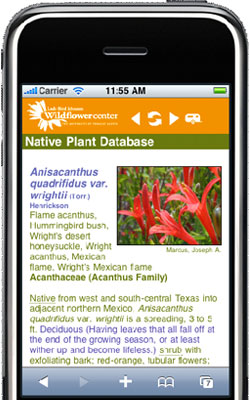
Did you know you can access the Native Plant Information Network with your web-enabled smartphone?

Ask Mr. Smarty Plants
Ask Mr. Smarty Plants is a free service provided by the staff and volunteers at the Lady Bird Johnson Wildflower Center.

rate this answer

Tuesday - January 10, 2012
From: Rio Medina, TX
Region: Southwest
Topic: Invasive Plants, Non-Natives, Herbs/Forbs
Title: Managing non-native invasive creeping yellow cress in Rio Medina TX
Answered by: Barbara Medford
QUESTION:
Due to my lawn mower dying and waiting for the shop to fix it my yard got a bit overgrown. I was walking around the yard looking at the blooming wildflowers and have discovered that one of them is Rorippa sylvestris. It did not come in with other plants that I planted and is no where else in the yard. Should I try to dig out or kill this invasive plant or is it ok to just keep mowing over it all the time? I don't want it to spread to anyone else's property.ANSWER:
Mr. Smarty Plants learns something from his visitors every day. We had never even heard of Rorippa sylvestris, Creeping yellow cress, and now we know it's not good. A member of the Mustard family, it does better in neglected moist areas. This plant is native to western Asia, the Caucasus, and Europe, and therefore falls out of our area of expertise. The goal of the Lady Bird Johnson Wildflower Center and Mr. Smarty Plant is to encourage the use of plants native not only to North America but to the areas in which those plants grow natively. However, we are always interested in controlling invasive plants, native or not. This article from B&D Lilies, Rorippa sylvestris, Noxious Imported Weed states that the plant has come into the United States as a hitchhiker on various imported bulbs. Since this is a lily nursery, they have hard words to say about improper importation, but the information about the plant itself is valuable. Pictures
There are a couple of things that puzzle us about your question. The information we mentioned above, that this plant does better in neglected moist areas, doesn't sound right for Medina County, in the southwestern part of Central Texas, where moisture in the soil is usually somewhat scarce. Another thing, this USDA Plant Profile map does not show this plant growing in Texas at all, but certainly does in most of the rest of the United States.
Going further, we looked in our Native Plant Database for members of the genus Rorippa, and found three native to Texas, all members of the Brassicaceae, or mustard family. The mustards are well known in Texas for being invasive, and a great many of those are natives, which doesn't excuse their invasiveness. These natives are:
Rorippa palustris (Bog yellowcress) - pictures
Rorippa palustris ssp. Fernaldiana (Fernald's yellowcress) - pictures
Rorippa teres (Southern marsh yellowcress) According to this USDA Plant Profile map, this plant is native in the Medina County area. Flora of North America still refers to it as a wet soil plant, found in boggy areas. Pictures
It really doesn't make much difference if the plant is native to your area, it is invasive and you don't wan't it reproducing. First of all, do not allow it to go to seed. If you mow it often enough and close enough, that will be accomplished. But this plant also travels by rhizomes, and digging them out or pulling them out will just encourage spread via those underground stems. Don't spray herbicide, those underground rhizomes are not affected by sprays, which will kill the neighboring plants and give the cress a new opportunity to spread.
We sometimes recommend cutting off a plant at the base, as near the soil as possible and, within 5 minutes, painting an undiluted herbicide onto that cut root, using a disposable sponge brush. You need to do it quickly because the stem will begin to heal over to protect those underground rhizomes. If the invasion is still a small one, and you are willing to persist in finding the plants and using the painting method, as well as mowing, you can make good progress in maintaining it.
Since all these plants like wet, boggy areas, perhaps you should consider improved drainage, or maybe you are overwatering the area?
However, wherever the infection came from, the source is likely still there, and you can never consider the problem permanently solved.
More Herbs/Forbs Questions
Plants for pavilion over fountain in Washington State
December 26, 2008 - I have a tall fountain in a 7 foot square which is surrounded by pavers. Inside the 7' square there is about a 2' mulched soil bed around the center fountain and an iron type pavilion that goes up h...
view the full question and answer
Is Evolvulus nuttallianus native to Central Texas and Deer Resistant?
June 11, 2015 - The website doesn't have much information about blue daze (Evolvulus nuttallianus. Is this plant native to Central Texas? Is it deer-resistant?
view the full question and answer
Moving School House lilies in Austin
March 02, 2009 - I live here in Austin in zipcode 78729. I have a clump of School House lilies in the back of the garden. I would like to move them to another bed under a tree. Is this a good time to move them? Should...
view the full question and answer
Texas natives that attract butterflies but not deer
December 13, 2012 - I'd like to have some plants in my garden that are butterfly attractors, but that whitetail deer won't like. I can find lists of butterfly plants, and lists of deer-resistant plants -- is there a li...
view the full question and answer
Yellowing leaves
May 06, 2008 - What causes yellowing of native garden plant leaves?
view the full question and answer
| Support the Wildflower Center by Donating Online or Becoming a Member today. |