Native Plants

Q. Who is Mr. Smarty Plants?
A: There are those who suspect Wildflower Center volunteers are the culpable and capable culprits. Yet, others think staff members play some, albeit small, role. You can torture us with your plant questions, but we will never reveal the Green Guru's secret identity.

Did you know you can access the Native Plant Information Network with your web-enabled smartphone?

Ask Mr. Smarty Plants
Ask Mr. Smarty Plants is a free service provided by the staff and volunteers at the Lady Bird Johnson Wildflower Center.

rate this answer

Monday - September 05, 2011
From: Jesup, GA
Region: Select Region
Topic: Pests, Herbs/Forbs
Title: Caterpillars devouring Blue Wild Indigo in Jesup GA
Answered by: Barbara Medford
QUESTION:
I have a false blue indigo growing in my garden. Every spring it gets defoliated by Genista moth caterpillars. It usually doesn't put out new growth until the next spring. This summer, it has put out new growth and now it is covered in the caterpillars again. Should I use some control to get rid of them or should I just let nature take it's course?ANSWER:
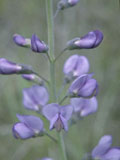
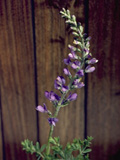
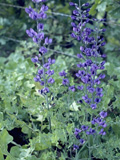
Baptisia australis (Blue wild indigo) is native to North America and to Georgia. According to this USDA Plant Profile Map, it is native to far northwestern Georgia, while Wayne County is in far southeastern Georgia. We don't think that is germane to your problem, just a comment. With a species name like australis, we were surprised that it was native to North America at all, but it turns out the "australis" means "southern" and not "from Australia." We are always learning new things. Also, when we searched on our Native Plant Database on the common name "False Blue Indigo" we got zero results. When we searched on the Internet the same way, this is the plant we got. The "False" may be part of a trade name, or it may be another totally different, and non-native, plant.
Now let's talk about the Genista caterpillar. How did you identify it as such? Here are pictures of the caterpillar and moth. From the National Society of Arboculture, please read this article on the Genista. In particular, note their comments on the use of pesticides. We have not found any research indicating that the Blue Wild Indigo is a larval host for the Genista moth; however, it would appear that is what you are seeing.
From BAMONA (Butterflies and Moths of North America, we found the information that wild blue indigo is a larval host to the Wild Indigo Duskywing.
From Gardens with Wings, we found pictures of the caterpillar, mature butterfly and chrysalis of this visitor to the Wild Blue Indigo.
Bottom Line: We learned that the Genista is a web producing caterpillar that attacks Texas laurel, crape myrtle, honeysuckle, and Laburnum. Larvae defoliate as well as spin webs. We would appeal to you not to employ pesticides, as they can do much more harm than good to the surrounding vegetation, butterflies, soil and water supply. Whatever is eating your plant, if you would rather not have a chewed-on plant, we suggest you pull it out. There is no point in wasting scarce resources on a plant that is not satisfactory to you.
From the Image Gallery
More Pests Questions
ID of insects attacking a Mexican Plum in Austin, TX
May 11, 2015 - I live in south austin and have a young 6' tall mexican plum. For the third year in a row it is getting eaten by small green 'leaf-rolling' worms. The destruction the past 2 years was so bad there ...
view the full question and answer
Insect damage to Meyer lemon in Texas
February 19, 2015 - Dear Mr. Smarty Plants,
I have a Meyer Lemon tree in Galveston. It produced a lot of lemons. However, something has bit up to quarter sized holes from the side edges of the leaf. Could you please...
view the full question and answer
Herbicide on Habiturf from Austin
May 31, 2014 - Can you recommend an herbicide that is safe to use on a Habiturf lawn?
I followed the directions to put in a new Habiturf lawn about a month ago. The grass seedlings are doing well in places, but ...
view the full question and answer
Failure to thrive of pecan trees in Las Vegas NV
October 11, 2009 - In April this year I purchased two 8-foot tall pecan trees in 3-foot square boxes from a local nursery and planted them here in Southern Nevada. I'm sure I dug a large enough hole to provide plenty ...
view the full question and answer
Problems with non-native parsley from Brooklyn NY
June 17, 2012 - Had beautiful flat leaf parsley plants recently turn yellow & die. Found black armadillo like bugs bored throughout the roots. Now they're spreading. How do I kill them without contaminating the pla...
view the full question and answer
| Support the Wildflower Center by Donating Online or Becoming a Member today. |