Native Plants

Q. Who is Mr. Smarty Plants?
A: There are those who suspect Wildflower Center volunteers are the culpable and capable culprits. Yet, others think staff members play some, albeit small, role. You can torture us with your plant questions, but we will never reveal the Green Guru's secret identity.

Did you know you can access the Native Plant Information Network with your web-enabled smartphone?

Ask Mr. Smarty Plants
Ask Mr. Smarty Plants is a free service provided by the staff and volunteers at the Lady Bird Johnson Wildflower Center.

rate this answer

Wednesday - September 07, 2011
From: Economy, IN
Region: Midwest
Topic: Pests, Trees
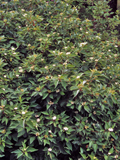
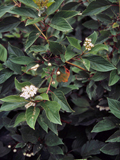
Title: Striped caterpillars on Cornus sericea (redtwig dogwood)
Answered by: Nan Hampton
QUESTION:
My red-twig dogwood has white/black striped caterpillars that congregate on the underside of the leaves and they are stripping the leaves. What can I do? They almost look like Monarch butterfly larvae. Would they feed on anything other than milkweed? Help!ANSWER:
Cornus sericea ssp. sericea (Redosier dogwood or redtwig dogwood) is listsed as a larval host for Celastrina ladon (Spring azure). It seems its caterpillar has at least two forms—both green and pinkish—depending on what it is feeding.
The sawfly larvae (Macremphytus tarsatus) is reportedly a significant pest on dogwood (Cornus) species. It, too, has several forms.
Here is a list of moth caterpillars that feed on Dogwood Shrubs and here are links to photos of some these caterpillars:
White-lined Bomolocha, Euthyatira pudens, Hyalophora cecropia, Hydrelia albifera, Hypagyrtis unipunctata, Probole amicaria, Schizura unicornis and Xanthotype sospeta.
Monarch butterflies do, generally, feed on milkweed plants, but they will also feed on other members of the Family Asclepiadaceae (Milkweed Family) such as Matelea species, Cynanchum species and Funastrum species. I doubt that they would feed on Cornus species in the Family Cornaceae (Dogwood Family).
Perhaps one of the caterpillars above is the one you are seeing. Whatever the caterpillars are, if they are destroying your dogwood tree, you probably want to remove them. It can be very effective to put on some gloves and simply pick them off and put them into a container of soapy water, vegetable oil or water with insecticidal soap. You can also consider using a natural insecticide, Bt, that comes as a powder that can be sprinkled on the leaves or can be mixed with water and sprayed. As with all insecticides, please read and carefully follow instructions for application and safety.
From the Image Gallery
More Trees Questions
Why are large numbers of leaves falling from my Live Oak trees in Driftwood, TX?
June 24, 2015 - Today is June 6, 2015 and I have noticed that for the last week and a half, only a few live oaks out of many, have been losing large numbers of green leaves and turning brown on the ground. I cannot ...
view the full question and answer
Can Texas Ebony seed pods be used as mulch in Edinburg TX
May 10, 2010 - I just bought a house with two large Texas ebony trees out front. I read somewhere that the seed pods could be used as mulch? Is this true? If so, would I need to remove the seeds from the pods fir...
view the full question and answer
Pecan Trees in Austin, TX prematurely losing their leaves.
September 03, 2010 - Why are the leaves on the pecan trees falling so early this year.
view the full question and answer
Is Carolina laurel (Prunus caroliniana) a good choice for San Juan Islands, Washington?
November 03, 2007 - What are the prospects for Carolina laurel here on San Juan Island, mixed in with thin stand of douglas fir, about 50 feet from shore, eastern exposure? Water is available but little sun because of l...
view the full question and answer
Watering a Chinquapin Oak in Austin, TX
June 22, 2014 - I have a question about watering. I planted a Chinquapin Oak about 7 months ago and it's about 8 feet tall and doing well. I water it weekly on a slow drip for about an hour. I expect that my job is ...
view the full question and answer
| Support the Wildflower Center by Donating Online or Becoming a Member today. |