Native Plants

Q. Who is Mr. Smarty Plants?
A: There are those who suspect Wildflower Center volunteers are the culpable and capable culprits. Yet, others think staff members play some, albeit small, role. You can torture us with your plant questions, but we will never reveal the Green Guru's secret identity.

Did you know you can access the Native Plant Information Network with your web-enabled smartphone?

Ask Mr. Smarty Plants
Ask Mr. Smarty Plants is a free service provided by the staff and volunteers at the Lady Bird Johnson Wildflower Center.

rate this answer

Friday - June 09, 2006
From: Silver Spring, MD
Region: Mid-Atlantic
Topic: Wildflowers
Title: Native, non-invasive plant seeds for each region in U.S.
Answered by: Dean Garrett
QUESTION:
I need to identify a wildflower from each region that we can package in custom packaging to use as giveaways at our member zoos and aquariums. Our project this year is called Conservation Made Simple and it focuses on backyard habitats. We would love to have flowering seeds that are critter friendly, non-invasive, etc. I understand that one size does not fit all, but am not expert enough to identify one per region. Can you help me?ANSWER:
We can direct you to sources of information that can help you decide which species to choose and we can provide some tentative suggestions. If the member zoos and aquariums are spread throughout the country, this should be quite an undertaking. I can understand why you might want to reduce the number of species you have to deal with.Ideally, the regions in which you offer the wildflowers would be ecoregions, but these do not correspond with state or cultural boundaries and they vary so greatly in extent that it would be hard to organize your project around them. Even native plant societies are organized at the state or county level and not by ecoregion.
The Wildflower Center has compiled Regional FactPacks arranged by state groupings that correspond roughly to traditional geographic regions like the Northeast, the Midwest, the Southwest, the Pacific Northwest, etc. This might be a good starting point. For each region, there's a list of wildflowers that you can peruse to help make a decision.
This may not be feasible for you, but I'm inclined to recommend that you consult with state native plant societies and use a local seed source for each state. This would further limit the size of the region that each species has to adapt to. The National Wildlife Federation has a longstanding Backyard Habitat Program and their website includes a Native Plant Finder function that enables you to sort wildflowers by state.
You might want to ensure that the planting requirements are as uniform across species as possible. For instance, choose only plants that require full sun.
Keeping a few common wildflower names in mind as you look over the suggested lists may help. A few well-known genera with broad ranges include:
Castilleja (paintbrushes) - concentrated in the west
Echinacea (coneflowers) - concentrated centrally and covering much of the east
Gaillardia (Indian blankets) - centrally concentrated
Helianthus (sunflowers) - continent-wide
Lupinus (lupines, bluebonnets) - concentrated in the west
Monarda (mints) - almost continent-wide
Ratibida (Mexican hats) - centrally concentrated
Rudbeckia (Susans, coneflowers) - concentrated in the east
Loosely following our FactPack regions, here are some initial species suggestions for full-sun wildflowers that have wide ranges and are relatively well-known (and thus most likely to be available commercially). Keep in mind that the FactPack regions are based on political boundaries and not ecoregions. None of the species will be fully adaptable to all habitats within the regions. This is especially true for regions that encompass large states such as California and Texas and for those with mountains, such as the Rocky Mountain region and the Southwest.
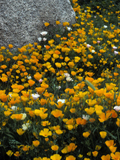
California region: California gold poppy (Eschscholzia californica)
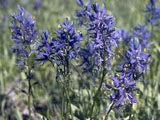
Northwest: Common Camas (Camassia quamash)
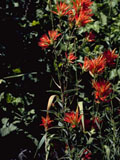
Rocky Mountain region: Meadow Paintbrush (Castilleja miniata)
Southwest: Desert Marigold (Baileya multiradiata)
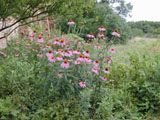
Midwest: Purple Coneflower (Echinacea purpurea)
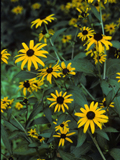
Northeast and Southeast: Black-Eyed Susan (Rudbeckia hirta)
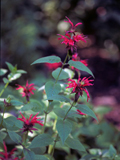
Mid-Atlantic: Scarlet Beebalm (Monarda didyma)
Our National Suppliers Directory provides a list of potential suppliers you can contact, both wholesale and retail.

More Wildflowers Questions
Bluebonnets in Colorado mountains
April 21, 2007 - Will Bluebonnets grow up in Colorado in the mountains?
view the full question and answer
Wildflower seeds that drop into a sidewalk crack
May 31, 2006 - This is an odd question. I'm writing a children's book about a seed that gets dropped in the crack of a sidewalk or driveway and blooms there. Can you tell me if there are any wildflowers that it ...
view the full question and answer
Illegal to pick wildflowers
March 14, 2004 - Is it illegal to pick wildflowers?
view the full question and answer
Wildflowers of April wedding in Liberty Hill TX
September 02, 2015 - We are planning a wedding for April 9 in Liberty Hill, TX (78642) and live on several acres. We would like to plant wildflowers on the land to use for bouquets and centerpieces. Could you please recom...
view the full question and answer
Is purple coneflower native to Colorado?
July 20, 2009 - I have seen the purple cone flower growing wild in Gunnison National Forest in Colorado. Is it a native to that state or has it been brought in?
view the full question and answer
| Support the Wildflower Center by Donating Online or Becoming a Member today. |