Native Plants

Q. Who is Mr. Smarty Plants?
A: There are those who suspect Wildflower Center volunteers are the culpable and capable culprits. Yet, others think staff members play some, albeit small, role. You can torture us with your plant questions, but we will never reveal the Green Guru's secret identity.

Did you know you can access the Native Plant Information Network with your web-enabled smartphone?

Ask Mr. Smarty Plants
Ask Mr. Smarty Plants is a free service provided by the staff and volunteers at the Lady Bird Johnson Wildflower Center.

rate this answer

Friday - June 24, 2011
From: Grand Rapids , MI
Region: Midwest
Topic: Trees
Title: Can a madrone be used as a house plant from Grand Rapids MI
Answered by: Barbara Medford
QUESTION:
Can a madrone tree be used as a house plant in Michigan? It is about 10" tall in a gal pot. Can a couple of trees be planted together to become one larger house plant? it's currently in a clay mix.ANSWER:
Actually we have no idea, because we can find no record of it being tried. Let us tell you what we know from our Native Plant Database about the 3 species of the Arbutus genus found in that database.
Beginning with Arbutus xalapensis (Texas madrone), which is native to New Mexico and Texas. This tree grows to 20 to 30 ft, requires full sun to part shade. From our webpage on this tree, here are the Conditions Comments:
"Conditions Comments: One of the most interesting and beautiful native trees of Texas, but temperamental to propagate or grow. Propagation requirements are complex, and it is very difficult to transplant successfully from the wild. In the landscape, it grows best in well-drained areas."
Then, there is Arbutus menziesii (Pacific madrone), native to California, Oregon and Washington. Needs sun or part shade. It grows 50 to 100 ft., with a spread of 15' to 75'. Here are its Condition Comments:
"Conditions Comments: A. menziesii has been shown to have a symbiotic relationship with mycorrhizal fungi. The fungi enable the madrone to take up nutrients in the soil. Arbutus spp. benefit from wind protection and may need to be trained early to central leaders to offset their tendency toward shrubbiness. A messy tree, A. menziesii is best planted away from well-used areas."
Arbutus arizonica (Arizona madrone) is native to Arizona and New Mexico; its native habitat is high altitude and oak woodlands. It requires full sun and sandy, acid well-drained soils. Pictures
So. if you already have a plant you want to experiment with, now you know what conditions are needed. Clay soil does not drain well, getting sufficient sunlight to a house plant would be a challenge, and disturbing the roots is going to cause problems, like sudden death.
Now you can conduct your own experimental laboratory in this matter, and let us know what happens.
From the Image Gallery
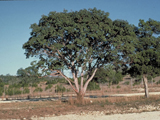

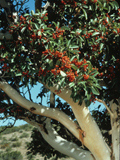
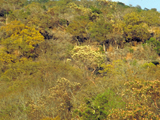
More Trees Questions
Willow Tree Early Leaf Fall
May 14, 2015 - I have a weeping willow tree and it put out great leaves this Spring and looked great, but now here in the middle of May all the leaves are turning yellow and falling off like it does in the fall. So ...
view the full question and answer
Are Royal Poinciana and Royal Empress trees the same?
October 09, 2015 - Hi, can you tell me if the Royal empress tree and the Royal Poinciana are the same tree?
view the full question and answer
Trouble with live oak in McKinney, TX
June 13, 2013 - We moved into a suburban home with a live oak tree with a trunk diameter of about 50". I noticed recently how yellow the leaves look compared to the other live oak in the yard. There is not a pattern...
view the full question and answer
Roots in mulch around Live Oak in Austin
March 10, 2011 - I have a 20 yr old Live Oak that has about 6-8 inches of mulch buildup around the base (I had landscaped around it). I went to break up the mulch to remove it from the base of the tree, but found it ...
view the full question and answer
Spacing for a Desert Willow Tree in California
July 07, 2016 - How close to a house can I plant a desert willow tree?
view the full question and answer
| Support the Wildflower Center by Donating Online or Becoming a Member today. |