Native Plants

Q. Who is Mr. Smarty Plants?
A: There are those who suspect Wildflower Center volunteers are the culpable and capable culprits. Yet, others think staff members play some, albeit small, role. You can torture us with your plant questions, but we will never reveal the Green Guru's secret identity.
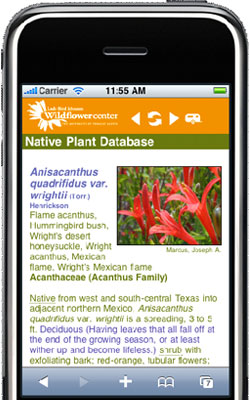
Did you know you can access the Native Plant Information Network with your web-enabled smartphone?

Ask Mr. Smarty Plants
Ask Mr. Smarty Plants is a free service provided by the staff and volunteers at the Lady Bird Johnson Wildflower Center.

rate this answer

Sunday - May 22, 2011
From: Cupertino, CA
Region: California
Topic: Non-Natives, Transplants
Title: Yellowing leaves on non-native podocarpus Cupertino CA
Answered by: Barbara Medford
QUESTION:
I recently planted a podacarpus granular and over half the leaves are turning yellow some are dead. What could be the problem? Is there something I can feed it? What should I do? I planted four & the other three are thriving! Help what should I do?ANSWER:
Every time Mr. Smarty Plants thinks he has heard of every plant known, another one pops up. Finding Podocarpus granular, however, turned out to be a different matter. We found information on a Podocarpus neriifolius, Brown pine, which had this sentence in it:
"Subrhytidome (under-bark) dark red or black (rarely with lighter pinkish stripes); less than 25 mm thick, 4.0-10.0; bark blaze consisting of one layer; strongly aromatic; pleasant; outer blaze red or brown, markings absent, fibrous or granular without splinters. (emphasis ours)."
That tree is apparently native to Papua New Guinea.
Another member of this genus is called Podocarpus gracilior, Fern Pine. Could that be the one you have? Here is a description from University of Virginia. This species apparently originated in East Africa and Madagascar.
Still another species on which we found information is this one from Floridata Podocarpus macrophylla, Japanese yew. it was described as being native to Japan and southern China. The only information we found on its care was:
"This durable and beautiful plant is virtually pest and disease free."
Since the Lady Bird Johnson Wildflower Center is dedicated to the growth, protection and propagation of plants native not only to North America but to the areas in which they are being grown, we have no information on this plant in our Native Plant Database, nor did we find any reference to yellowing leaves on the plant. We suggest you read all of our references to see if you can pick up on something we missed.
One final problem which applies to native as well as non-native plants is that of transplant shock. You say you planted four and the other three are all right. Sometimes root damage or improper placement of a plant can cause it to go into shock. Sometimes a plant is already damaged or rootbound in the pot when it is purchased, all possibilities you should explore. Do not fertilize. Any plant under stress should never be fertilized, as it will only encourage growth on a plant struggling to survive.
More Non-Natives Questions
Care for non-native plumeria in Inverness FL
October 05, 2009 - I have several plumeria plants that I planted in the ground this spring. I will soon need to dig them up and store them in the garage for the winter, as I left some last year that died with the frost...
view the full question and answer
Privacy hedge for Burleson, TX.
April 09, 2013 - I moved out to the country away from the hustle and bustle only to find that I have less privacy out there because of open land. I hear children screaming and dogs barking from 1/4 mile away. I want t...
view the full question and answer
Why is non-native peach tree not going dormant in Owensville IN
December 19, 2011 - I have a peach tree I grew from a peach pit. It is about 2 years old. I planted the tree in my yard this summer. It is now about 3' tall. My problem is it is not going dormant. We have had several fr...
view the full question and answer
Wintering of non- native jasmine in Newton KS
September 18, 2010 - Hi Mr. Smarty Plants,
I received a gorgeous jasmine for mothers day and I planted it in my front yard in the flower area close to the house. Can I keep it there all winter or do I need to dig it up a...
view the full question and answer
Plant for a salt water pool in Australia
September 27, 2011 - What plant is a perfect plant for small areas around a salt water pool?
view the full question and answer
| Support the Wildflower Center by Donating Online or Becoming a Member today. |