Native Plants

Q. Who is Mr. Smarty Plants?
A: There are those who suspect Wildflower Center volunteers are the culpable and capable culprits. Yet, others think staff members play some, albeit small, role. You can torture us with your plant questions, but we will never reveal the Green Guru's secret identity.

Did you know you can access the Native Plant Information Network with your web-enabled smartphone?

Ask Mr. Smarty Plants
Ask Mr. Smarty Plants is a free service provided by the staff and volunteers at the Lady Bird Johnson Wildflower Center.

rate this answer

Sunday - May 08, 2011
From: Austin, TX
Region: Southwest
Topic: Trees
Title: Protecting base of Texas Madrone tree in Austin
Answered by: Barbara Medford
QUESTION:
3 years ago, I successfully transplanted a 1-gallon Texas Madrone on the north side of an Ashe Juniper. The Madrone is thriving but the juniper, which has been a great "nurse", is dying. I am looking for suggestions for plants that will shade the base of the Madrone. I'm thinking I need plants that grow fairly rapidly; so far only Morella cerifera has come to mind. I welcome your suggestions.ANSWER:
By coincidence, this particular member of the Mr. Smarty Plants team was touring some people around the Wildflower Center this week and observed one of the Arbutus xalapensis (Texas madrone) on-site at the Center. Because we had your question in mind, we looked it over to see what was there. Actually, there was nothing directly shading its base, which happened to be in full sun when we were there. However, it was in a corner of a wooden fence, with some low-growing perennials fairly close by, and more trees a little farther. This was a mature tree, and gorgeous, with the red bark and a curving trunk, so you are probably right that your smaller tree still needs some protection.
Then, on the Wildflower Center Garden Tour, we were greeting people at a property on the Tour that had madrone trees down in a canyon at the base of a slope. The advice from the owner of that property was "don't do a thing." Madrones don't like any disturbance, are difficult to propagate from seed and resistant to being transplanted. The madrones in the second place had come up voluntarily from seed. One of the Center horticulturists said to just leave the framework of the cedar for as long as possible, that would cast some shade, and not cause any meddling with the madrone.
And, finally, we all agreed that planting a wax myrtle there would not be the best idea. A wax myrtle is a fine, evergreen plant, but requires more water than the madrone. Having excess water in the vicinity might affect the madrone negatively and, again, digging a hole to plant a shrub of any kind would be dangerous for the madrone roots.
For more information, here is a previous Mr. Smarty Plants answer on propagation of the madrone.
From our Native Plant Image Gallery:
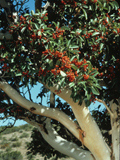
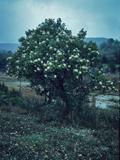
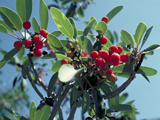
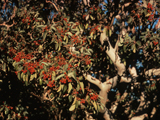
More Trees Questions
Evergreen tree to provide block for treehouse in Central Texas
April 02, 2010 - I live close to Austin TX and need an evergreen tree to block neighbor's newly constructed, metal roof tree house. It looms over our garden and yard - can you suggest a nice evergreen tree for hot m...
view the full question and answer
Possible disease on Eastern Redbud
October 06, 2007 - Our Eastern Redbud appears to be suffering from our recent drought. The leaves are turning brown in July/August on a few branches. A few black spots appear on the leaves before they turn brown. Ot...
view the full question and answer
Aphids in pecan tree from Austin
July 14, 2012 - Last year at this time (midsummer) everything under the canopy of our 60+ year old pecan tree was covered with a sticky substance--plants, lawn furniture, concrete pool deck..Since we had never seen t...
view the full question and answer
Can the non-native ylang ylang tree grow outdoors in Arizona
July 14, 2015 - Can the ylang ylang tree grow outdoors in Casa Grande, Arizona?
view the full question and answer
Planting a tulip poplar in Virginia Beach VA
November 10, 2009 - Hi. I would like to plant a Yellow Poplar, 'Tulip Tree' in my front yard. I will not be able to plant this tree until after November 15th. The tree will receive direct sun and will be exposed to hea...
view the full question and answer
| Support the Wildflower Center by Donating Online or Becoming a Member today. |