Native Plants

Q. Who is Mr. Smarty Plants?
A: There are those who suspect Wildflower Center volunteers are the culpable and capable culprits. Yet, others think staff members play some, albeit small, role. You can torture us with your plant questions, but we will never reveal the Green Guru's secret identity.

Did you know you can access the Native Plant Information Network with your web-enabled smartphone?

Ask Mr. Smarty Plants
Ask Mr. Smarty Plants is a free service provided by the staff and volunteers at the Lady Bird Johnson Wildflower Center.

rate this answer

Monday - May 09, 2011
From: San Jose, CA
Region: California
Topic: Trees
Title: Trees for small spaces from San Jose CA
Answered by: Barbara Medford
QUESTION:
What tree can you plant in a corner of a yard 3ft from a fence? What is the best shade tree for a small yard with a pool?ANSWER:
Mr. Smarty Plants hates to disappoint gardeners, but some requests are for plants that really won't work in the described situation. There are several trees that could be planted in the corner of a fence that would do well in your area. The questions you will have to ask yourself are: (1) can the roots go under the fence and are they going to interfere with any paving or landscaping on either side, yours or the neighbor's? and (2) ditto for the top of the tree. Depending on how tall the tree and how tall the fence, the crown or leafy top may already be at the top of the fence or soon get there. Then what? Is the tree going to shade something in your neighbor's yard that he doesn't want shaded? Or drop leaves, flowers, seeds, etc. on both sides of the fence? In terms of shade in a small yard with a pool, we don't want to be flip, but have you considered a large umbrella?
Roots of trees generally extend at least as far out as the shadow of the canopy of the tree. This area is referred to as the Protected Root Zone (PRZ). While a tree and its rootball would probably initially fit into the 3 ft. space in the fence corner, the roots will quickly grow beyond it. Additionally, the roots of the tree have the potential to damage/crack any concrete they encounter as they grow trying to reach water and oxygen.
We are frequently asked for "taproot trees," on the assumption that a root that grows straight down will not interfere with concrete walks, driveways, sidewalks and foundations. Alas, some trees do begin with a taproot but there are few trees with a true taproot; as time goes by roots will spread from that center root, both in search of water and nutrients and also as a base to stabilize the tree in the ground. A tree tall enough, and with comparable width to provide shade for your pool area, is going to have roots extending far beyond the initial area, if either the tree or the pool survive the planting there. A tree big enough to cast shade, say, 20 ft. tall, will usually have about the same spread-20' wide. The roots beneath that tree will normally spread out from two to three times farther than the crown.
There are shrubs that might fit into that corner space and or not interfere with your pool, but they will not get big enough to cast appreciable shade. What they will cast is leaves, twigs, bugs, fruit and seeds into that pool, that will need cleaning up.
We are going to list a few shrubs that are native to the Santa Clara Co. area in central coastal California, USDA Hardiness Zone 9. Shrubs have less invasive roots than trees, can maintain a space in the landscape; some are evergreen, but they won't get big enough for shade. We will find suggestions for you by going to our Recommended Species section, clicking on Northern California on the map, and searching on the sidebar at the right-hand side of the page on "shrub" for Habit. Follow each plant link to our webpage on that plant to find out more about size, growth habits, care, sun requirements, etc. You can use the same technique to make other choices or select trees, herbaceous blooming plants and so forth.
Shrubs for Central California:
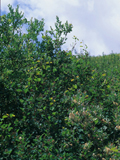
Amelanchier alnifolia (Saskatoon serviceberry) - deciduous, 3-18 ft. tall, blooms white April to June, can grow in sun, part sun or shade
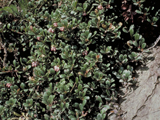
Arctostaphylos uva-ursi (Kinnikinnick) - trailing, 1-3 ft., evergreen, blooms white, pink March to June, sun, part shade or shade
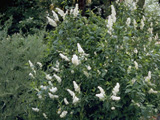
Ceanothus velutinus (Snowbrush) - evergreen, 6-12 ft., sun, part shade or shade, blooms white April to August
Garrya elliptica (Wavyleaf silktassel)- evergreen, 10 ft., sun or part shade, blooms white December to February. Pictures from Google.
From our Native Plant Image Gallery:
More Trees Questions
Pruning Wax Myrtle trees & bushes
February 28, 2016 - When is the best time of year to prune Wax Myrtle trees & bushes.
view the full question and answer
Survivors of a Cedar Elm thicket thinning.
April 12, 2013 - I thinned a thicket of cedar elm saplings, but a few are now leaning excessively. Will they straighten up over time or should I go ahead and cut them too? Thanks!!
view the full question and answer
Sun-scorched Cherry laurel (Prunus caroliniana)
June 24, 2009 - I live in south Central Texas 30 miles north of San Antonio. I am looking for a good evergreen hedge plant that once established will not die if I forget to water it a few days and is deer resistant....
view the full question and answer
Tall, narrow evergreen for front of house in Flower Mound, TX
June 21, 2009 - Please recommend a tall, narrow evergreen to be placed at the front corner of my house.
view the full question and answer
Protection of live oak trees from covering by concrete patio
February 02, 2008 - I am thinking about pouring a large cement patio around my live oak trees in my yard. I live in Rockport Tx. How far should the edge of the cement be, from the base of the tree? Will the patio kill th...
view the full question and answer
| Support the Wildflower Center by Donating Online or Becoming a Member today. |